

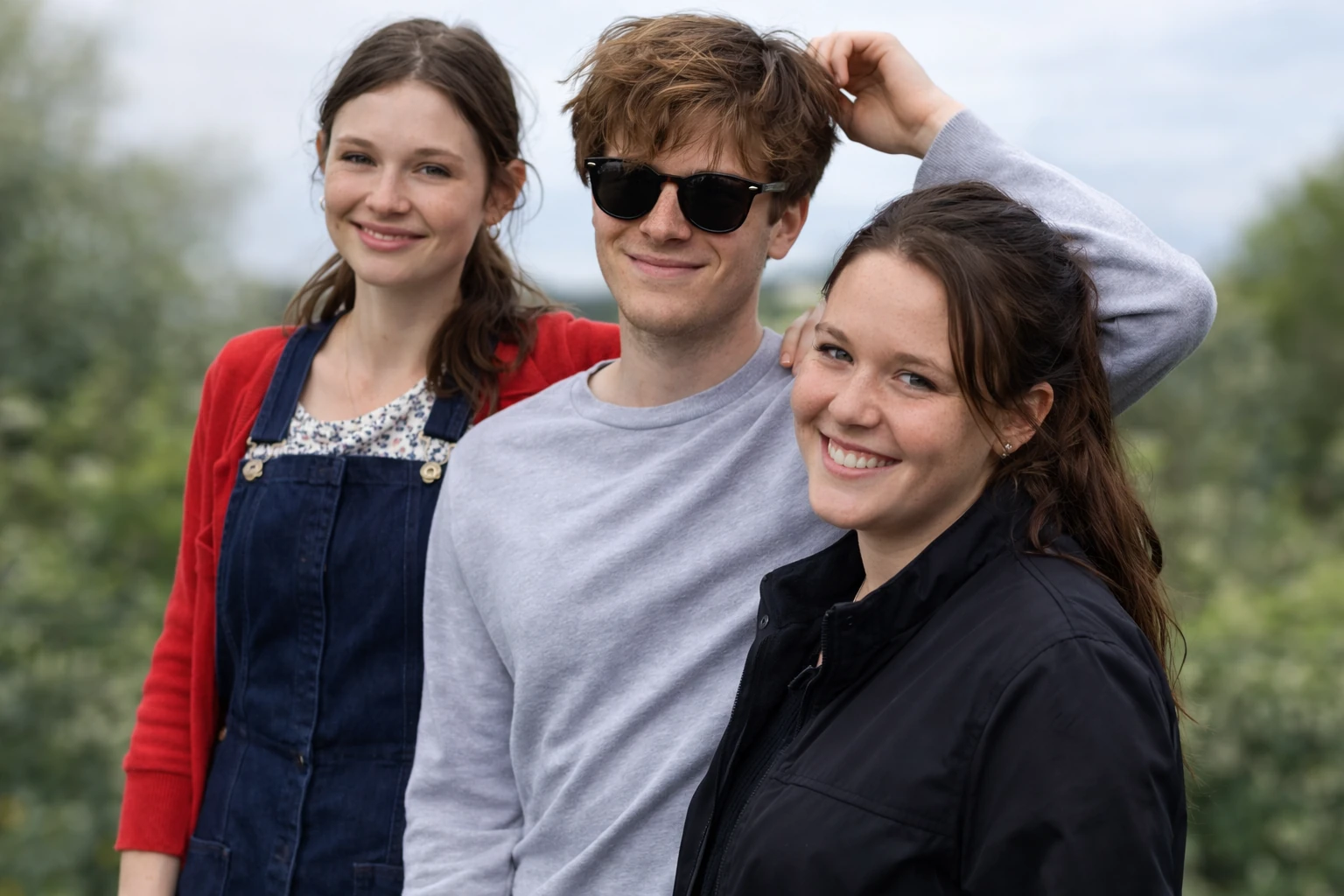
There is a certain kind of public curiosity that gathers around famous families—names that echo across film credits, music charts, and television history. Dulce Bextor sits just at the edge of that orbit. She is not a celebrity in the conventional sense, yet her name appears often enough in searches and online profiles to invite questions: Who is she? How is she connected to Sophie Ellis-Bextor? And why does so little solid information seem to exist?
The truth is both simple and elusive. Dulce Bextor appears to be a private individual from a family that includes some of Britain’s most recognizable cultural figures. Unlike her half-sister Sophie Ellis-Bextor, whose voice and image have been part of pop culture for more than two decades, Dulce has remained largely outside public view. That absence has allowed speculation to fill the gaps, creating a patchwork of claims that require careful handling. What follows is a biography built on what can be responsibly known, while acknowledging the limits of the public record.
Early Life and Family Background
Dulce Bextor was born in England in the late 1990s, with most available records pointing to 1997 as her likely year of birth. This places her in a generation shaped by a very different media environment from that of her older half-sister Sophie, whose early career unfolded in the late 1990s and early 2000s under intense press attention. Dulce’s upbringing, by contrast, appears to have taken place largely outside that glare.
Her father, Robin Bextor, is a British film and television director and producer with a steady career in documentaries and music-related programming. His work includes projects connected to major cultural figures such as Paul McCartney and Eric Clapton, as well as factual programming for television. Robin’s professional life has been public enough to establish a reliable family anchor, even when details about his children remain sparse.
Dulce’s mother is Polly Mockford, who has maintained a much lower public profile than either Robin Bextor or Sophie Ellis-Bextor’s mother, Janet Ellis. Janet Ellis, a well-known television presenter in the UK, is Sophie’s mother from Robin Bextor’s earlier relationship. This makes Dulce one of Sophie Ellis-Bextor’s younger half-siblings, part of a blended family that spans both media and music.
Family records and genealogy-style databases suggest that Dulce grew up alongside siblings Bertie Bextor and Maisy Bextor. While her siblings have small but traceable professional footprints in public databases, Dulce’s presence is noticeably lighter. That difference alone hints at a deliberate or natural move toward privacy rather than public-facing work.
Growing Up Near the Spotlight
Not many people know this, but growing up adjacent to fame can shape a life just as strongly as being in it. For Dulce Bextor, the proximity to public figures likely meant exposure to creative industries from an early age, even if she never pursued a visible role within them. Her father’s work in television and film would have brought her into contact with production environments, while her half-sister’s music career unfolded on a global stage.
Sophie Ellis-Bextor’s rise to fame was swift and highly visible. She first gained recognition as the lead singer of the indie rock band Theaudience in the late 1990s before launching a successful solo career with hits like “Murder on the Dancefloor” and “Take Me Home.” Those songs became defining tracks of early-2000s pop, securing her a lasting place in British music culture.
For younger siblings like Dulce, that kind of fame often creates a complicated dynamic. There is access to opportunity, but also a clear contrast between public life and private identity. Some family members choose to follow similar paths, while others step deliberately away from the spotlight. Dulce appears to fall into the latter category, though there is no public statement confirming that choice.
The truth is, there are no widely documented interviews, personal essays, or public appearances that reveal Dulce’s own perspective on growing up in this environment. That absence is telling in itself. It suggests either a conscious decision to remain private or simply a life that has not intersected with media coverage in a significant way.
Education and Early Interests
One of the most frequently repeated claims about Dulce Bextor is that she pursued studies related to animal care or conservation, with some sources naming institutions such as the University of Reading. These details appear consistently across certain online profiles, often accompanied by descriptions of work with animals or roles in wildlife settings.
But here’s the thing: those claims are not strongly supported by independently verifiable records. University directories, official staff listings, and institutional publications do not clearly confirm her enrollment or employment in the way they would for a public-facing professional. That does not mean the information is false, but it does mean it cannot be treated as confirmed fact.
What can be said with more confidence is that these recurring themes—animals, conservation, and hands-on care—may reflect how people interpret her absence from entertainment or media industries. When someone from a creative family does not pursue a similar career, the internet often fills in a different narrative, sometimes without firm evidence.
The broader pattern here is common. Private individuals connected to public figures often have fragments of personal detail attached to their names, some of which are accurate and some of which are not. Without direct confirmation, those fragments remain just that—possibilities rather than facts.
Career and Public Profile
Unlike her father and half-sister, Dulce Bextor does not have a clearly documented career in film, television, or music. There are no widely recognized credits on major industry databases, no confirmed roles in high-profile productions, and no public-facing professional portfolio that can be traced with confidence.
Some online biographies attempt to assign her a career in animal care, including claims of work as a keeper or conservation professional. While these descriptions are specific, they tend to originate from the same cluster of lightly sourced websites rather than from primary or institutional records. As a result, they should be treated with caution.
What’s striking is not just the lack of confirmed information, but the contrast with her siblings. Bertie Bextor has been associated with television production roles, while Maisy Bextor has an IMDb presence that suggests involvement in the entertainment industry. Dulce, by comparison, remains largely absent from these platforms.
That absence does not diminish her significance as a subject of public curiosity. Instead, it reframes her story as one about privacy in an era when even indirect connections to fame can generate attention. Dulce’s profile is shaped less by what she has done publicly and more by what has not been made public at all.
Relationship with Sophie Ellis-Bextor
The connection between Dulce Bextor and Sophie Ellis-Bextor is the central reason her name appears in search results. Sophie, born in 1979, is nearly two decades older, and their relationship exists within the context of a blended family formed through Robin Bextor’s relationships.
Sophie has spoken publicly about her family life in interviews, often describing a close-knit environment that includes her children and extended relatives. However, she has not frequently discussed her half-siblings in detail, at least not in widely reported interviews. This is not unusual, as many public figures choose to keep certain family relationships out of the spotlight.
What can be inferred is that Dulce grew up during a period when Sophie’s career was already established. That timing would have shaped their dynamic, with Sophie occupying a public role while Dulce’s life unfolded more privately. The two worlds likely intersected at family events and personal gatherings rather than in professional settings.
The lack of public commentary about their relationship does not suggest distance or conflict. It simply reflects a boundary between public and private life that many families maintain, particularly when one member is in the public eye.
Public Image and Media Representation
Dulce Bextor’s public image is unusual because it is almost entirely constructed by others. Without interviews, official profiles, or social media presence tied clearly to her identity, the narrative around her has been built through secondhand sources and speculative biography pages.
This creates a situation where the same details are repeated across multiple sites, giving the impression of confirmation even when the original source is unclear. It is a common pattern in online publishing, especially for individuals connected to well-known figures.
What’s surprising is how quickly a minimal set of facts can expand into a full narrative. A name, a family connection, and a likely birth year become the foundation for descriptions of personality, career, and lifestyle. Over time, these details can take on a life of their own, even if they were never independently verified.
For readers, this makes it essential to approach such profiles with a degree of skepticism. The absence of reliable information is not a gap to be filled with assumptions, but a reality to be acknowledged. In Dulce Bextor’s case, that reality defines her public image more than any specific achievement or role.
Personal Life and Privacy
Very little is publicly confirmed about Dulce Bextor’s personal life, including her relationships, residence, or daily activities. There are no widely reported details about a partner, children, or significant life events that would typically appear in a public biography.
This level of privacy is increasingly rare in the digital age, where even minor public figures often have extensive online footprints. Dulce’s minimal presence suggests either a conscious effort to remain private or simply a life that has not intersected with public platforms in a notable way.
The distinction matters because it shapes how her story should be told. Without direct statements or verified reports, any attempt to describe her personal life in detail would move beyond responsible reporting. Respecting that boundary is part of maintaining accuracy as well as fairness.
In many ways, Dulce Bextor represents a counterpoint to the idea that everyone connected to fame becomes a public figure. Her story shows that it is still possible, though increasingly uncommon, to remain largely unknown despite a recognizable family name.
Financial Status and Net Worth
There are no credible public estimates of Dulce Bextor’s net worth. Unlike her half-sister Sophie Ellis-Bextor, whose income can be linked to music sales, touring, and media appearances, Dulce does not have a publicly documented career that would allow for meaningful financial analysis.
Some online profiles attempt to assign approximate figures, but these are not backed by reliable sources and should not be treated as accurate. Without confirmed information about her profession or business activities, any discussion of net worth remains speculative.
By contrast, Sophie Ellis-Bextor’s financial profile is more transparent due to her long-standing presence in the music industry. Her earnings have been shaped by album sales, live performances, and licensing deals, particularly following the resurgence of “Murder on the Dancefloor” in recent years.
The comparison highlights the gap between public and private lives within the same family. While Sophie’s career has been measured and reported in detail, Dulce’s financial situation remains entirely outside the scope of public knowledge.
Where Dulce Bextor Is Now
There is no widely reported update on Dulce Bextor’s current activities, location, or professional status. She does not appear to maintain a high-profile social media presence, nor does she feature in recent news coverage or interviews.
This absence does not suggest inactivity or obscurity in a personal sense. It simply reflects a life that has not been documented by public media. Many people lead full, meaningful lives without leaving a trace in searchable databases, and Dulce Bextor appears to fall into that category.
The ongoing interest in her name is tied less to what she is doing now and more to her connection to a family that continues to attract attention. As long as Sophie Ellis-Bextor remains an active public figure, that curiosity is likely to persist.
What’s clear is that Dulce’s story is still being written outside the public record. Whether that changes in the future is uncertain, but for now, her identity remains defined by privacy rather than publicity.
Frequently Asked Questions
Who is Dulce Bextor?
Dulce Bextor appears to be a private British individual connected to the Bextor family. She is widely believed to be the daughter of film director Robin Bextor and Polly Mockford, which makes her a younger half-sister of singer Sophie Ellis-Bextor. Beyond that, publicly confirmed details about her life are limited.
Is Dulce Bextor famous?
No, Dulce Bextor is not known as a public figure in her own right. Her name appears in search results primarily because of her family connections rather than a documented career in entertainment, media, or another public field.
What does Dulce Bextor do?
There is no confirmed information about Dulce Bextor’s profession. Some sources suggest work in animal care or conservation, but these claims are not strongly supported by verifiable records. As a result, her career remains unclear.
How is Dulce Bextor related to Sophie Ellis-Bextor?
Dulce Bextor is believed to be Sophie Ellis-Bextor’s younger half-sister. They share the same father, Robin Bextor, but have different mothers. This relationship places Dulce within a well-known British media and entertainment family.
What is Dulce Bextor’s age?
Most available records suggest that Dulce Bextor was born in 1997. However, this information comes from secondary sources rather than official confirmation, so it should be treated as an estimate rather than a verified fact.
Does Dulce Bextor have social media?
There is no widely recognized or verified social media presence associated with Dulce Bextor. If she does use social platforms, they are not publicly linked to her identity in a way that has been confirmed by reliable sources.
Conclusion
Dulce Bextor’s story is unusual not because of what is known, but because of how much remains unconfirmed. In a culture that often turns even distant connections to fame into full biographies, her profile stands out for its restraint. She is part of a family with a strong presence in British media and music, yet her own life has stayed largely outside that sphere.
That contrast offers a reminder that visibility is not inevitable. Even in an era defined by constant sharing and documentation, some individuals maintain a level of privacy that resists easy categorization. Dulce Bextor appears to be one of them.
Her biography, as it stands, is less about achievements in the public eye and more about the boundaries between public and private life. Those boundaries may shift over time, but for now, they define how her story can be told responsibly.
If anything changes—if she steps into a public role or chooses to share more about her life—the narrative will expand. Until then, the most accurate portrait is also the simplest one: a private person connected to a well-known family, whose story remains largely her own.
