

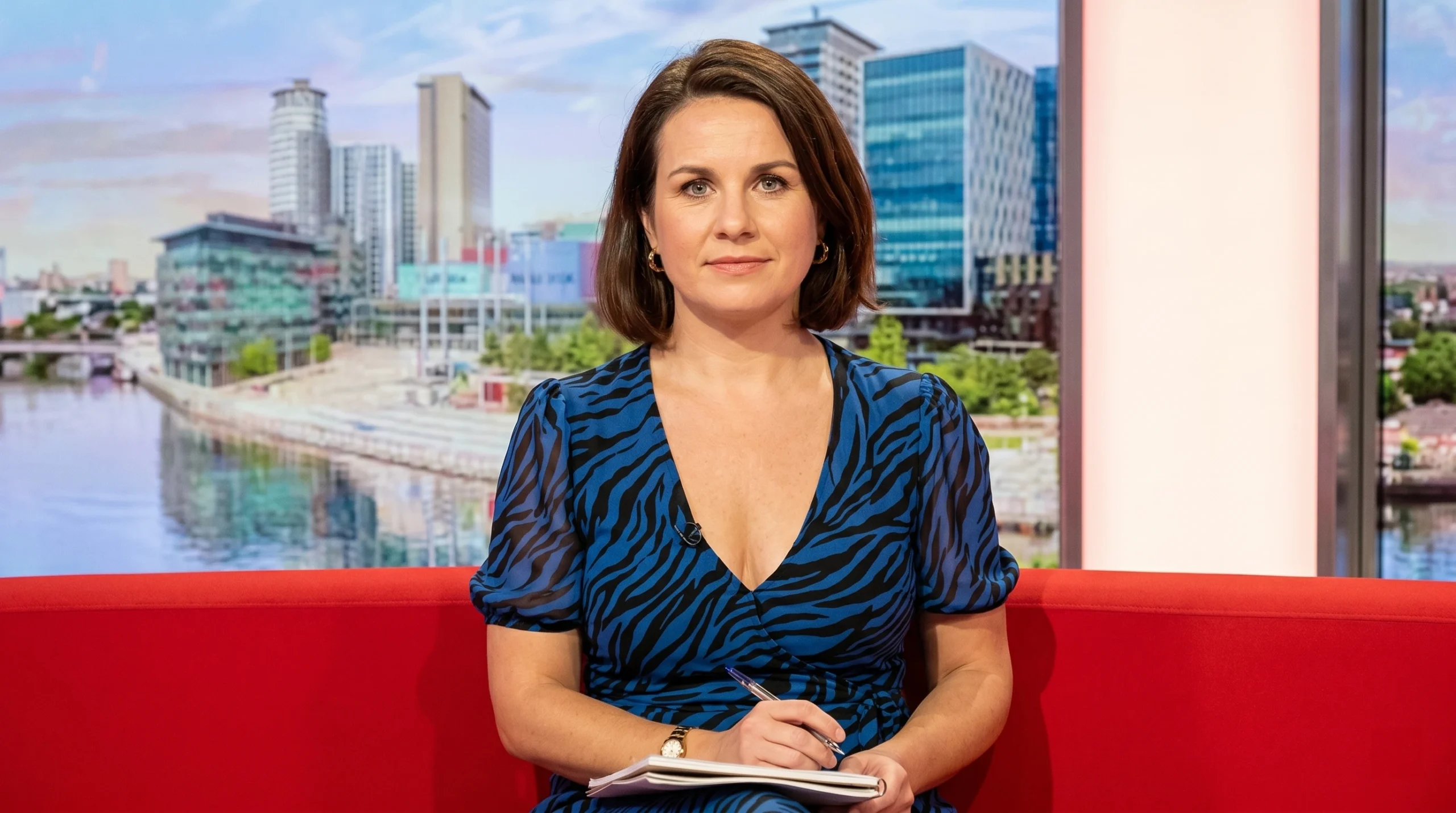
Nina Warhurst is 45 years old, and her age tells part of a larger story about experience, patience, and the long road to becoming one of the BBC’s most recognisable news presenters. Born on October 28, 1980, she has built her career not through sudden celebrity but through years of reporting, regional broadcasting, political journalism, and live national television. For many viewers, she became a familiar presence on BBC Breakfast, where she explained business and consumer stories in a calm, direct style. Her move into BBC News at One confirmed what longtime viewers already knew: Warhurst is a broadcaster shaped by substance, not spectacle.
Searches for “nina warhurst age” usually begin with a simple question, but they often lead to something more revealing. People want to know how old she is, but they also want to understand how she got here, where she is from, whether she has a family, and why she seems so grounded on screen. Warhurst’s appeal comes from that combination of authority and ordinariness. She looks and sounds like someone who knows the newsroom, but also someone who has lived enough outside it to understand the people watching at home.
Nina Warhurst’s Age and Birthday
Nina Warhurst was born on October 28, 1980, which makes her 45 years old in 2026. She will turn 46 on October 28, 2026. That date is the clearest way to avoid confusion, because some online profiles become outdated after her birthday passes. If a page still describes her as 44, it was likely written before her October 2025 birthday or has not been updated.
Her full name is widely listed as Nina Louise Warhurst, and she is known professionally as Nina Warhurst. She is a British journalist, newsreader, and television presenter whose work has stretched across regional news, politics, business, consumer affairs, and national broadcasting. Her age places her in a stage of her career where long experience and higher visibility have come together. That is one reason the search interest around her has grown as her BBC profile has expanded.
Age can be a strangely loaded subject for women on television, especially in news. Male broadcasters are often allowed to age into authority without comment, while women are more frequently measured against appearance, family life, and public expectations. Warhurst’s career offers a better way to read the number. At 45, she is not a newcomer or a veteran fading from view; she is a journalist in full professional stride.
Early Life in Greater Manchester
Nina Warhurst was born in Wythenshawe, Greater Manchester, and her public identity has stayed closely tied to the North West of England. That connection is not a small biographical detail. It has shaped the way viewers understand her voice, her manner, and the kind of journalism she has often done. Even as she moved into national roles, she retained the feel of a broadcaster rooted in a specific place.
Greater Manchester has long produced journalists and presenters with a direct style, partly because the region itself demands range. A reporter there may cover local politics one day, business closures the next, then social issues, transport, crime, football, or national stories with northern consequences. Warhurst’s later work on business and consumer stories drew on that habit of making policy feel local. Her broadcasting career never seemed detached from ordinary workplaces, households, and communities.
Her upbringing has generally been discussed through public, career-relevant facts rather than private detail. That is important because Warhurst is a public journalist, not a personality who trades on exposure. What is known is enough to explain her professional grounding: she came from Greater Manchester, trained seriously, and built her career through reporting rather than performance alone. The steadiness viewers now associate with her did not arrive by accident.
Education and Early Ambitions
Warhurst studied History and Politics at the University of Edinburgh, a combination that fits much of her later career. History trains a person to think about context, cause, and consequence, while politics sharpens attention to power, institutions, and public language. Those subjects are not ornamental for a journalist. They give a reporter the tools to understand why decisions are made and who is affected by them.
She later studied broadcast journalism at the University of Westminster, where the focus shifted from academic understanding to the practical demands of news. Broadcast journalism requires compression, judgment, and discipline. A television reporter has to know what matters, say it clearly, and do it often under time pressure. Warhurst’s later on-air style shows that training: plain English, controlled delivery, and an instinct for what viewers need first.
Before becoming a national BBC figure, she also had early screen experience outside the straight news path. Public profiles note acting credits when she was younger, including appearances in television drama. Those early experiences did not define her adult career, but they may have made the camera feel less foreign. Still, journalism became the serious path, and she built that path through newsroom work rather than celebrity visibility.
Building a Career in Regional Broadcasting
Warhurst’s career developed through regional broadcasting, including work connected to Channel M and BBC North West. Regional journalism can be underestimated by viewers who mainly watch national bulletins, but it is one of the toughest training grounds in television. Reporters have to be quick, accurate, adaptable, and close enough to communities that mistakes are noticed. It is a place where credibility is earned story by story.
Her work in the North West gave her experience across subjects that later became central to her national role. She covered politics, local issues, and public affairs, learning how to explain decisions made by councils, companies, courts, and governments. That kind of reporting builds more than confidence. It builds the habit of asking how a story changes daily life for people who may never appear in the studio.
In 2017, Warhurst won recognition as Best Regional Journalist at the Royal Television Society’s North West awards. That award came before her broader fame on BBC Breakfast, which matters when judging her career. She was not a presenter discovered by national television and then trained in public. She had already earned respect in the profession before many casual viewers knew her name.
BBC Breakfast and National Recognition
Nina Warhurst became a familiar national face through BBC Breakfast, where she appeared regularly before being appointed business presenter in 2020. That role brought her into millions of homes at a time when business news was no longer a specialist subject tucked away for investors. Viewers were trying to understand job insecurity, inflation, energy bills, interest rates, wages, and the cost of daily life. Warhurst’s job was to make those pressures clear without reducing them to slogans.
The business presenter role suited her because she treated economic stories as human stories. She could report from factories, shops, farms, offices, and high streets, linking the numbers to real people. That approach made her stand out from presenters who speak fluently about markets but less clearly about households. Warhurst’s strength was not making business sound grand; it was making it understandable.
BBC Breakfast also gave viewers a sense of her personality. She came across as warm but not performative, sharp but not showy, and relaxed without seeming casual about the news. Morning television has a strange demand: presenters must be approachable enough for breakfast-time viewing but serious enough to handle breaking news. Warhurst learned to occupy that space with a natural ease.
Becoming BBC News at One Presenter
Warhurst’s move to BBC News at One marked a major step in her career. The programme is one of the BBC’s established national news bulletins, and presenting it requires a different kind of authority from a magazine-style morning programme. The pace is tighter, the tone is more formal, and the responsibility is clear. A presenter has to guide viewers through the day’s main events without becoming the story.
Her appointment also mattered because BBC News at One became part of the BBC’s broader move to strengthen output from Salford. For Warhurst, that was not just a change of studio. It connected national news with the region that had shaped much of her professional life. In that sense, her career came full circle: the broadcaster rooted in Greater Manchester was helping lead a national bulletin from the North West.
At 44 when the move was first reported, and 45 soon after, Warhurst stepped into the role with more than enough experience behind her. That timing says something useful about how broadcast journalism works. The most visible roles often come after years of quieter work, not before it. Warhurst’s age, in this context, reflects readiness rather than lateness.
Marriage, Children, and Family Life
Nina Warhurst is married and has children, and she has spoken publicly about motherhood in ways that many viewers have found relatable. Public reporting widely identifies her husband as Ted, though Warhurst tends to keep the details of her marriage private. That restraint is consistent with the way many serious journalists handle family life. They may share enough to be human, but they do not turn loved ones into public material.
She has three children, and her experience as a working mother has sometimes become part of the way audiences connect with her. Television news can make presenters look polished and removed from everyday pressures, but Warhurst has often seemed alert to the messier realities of family and work. That does not mean her private life should be treated as an open file. It means her public comments have added texture to how viewers understand her.
Her family story has also included painful public honesty about her father’s dementia. Warhurst has spoken about that experience with care, and it has shown another side of her public voice. She can handle difficult personal subjects without turning them into spectacle. That ability is part of what makes her feel trustworthy on screen.
Public Image and On-Screen Style
Warhurst’s public image rests on clarity, warmth, and a lack of theatrical self-importance. She is not a presenter who seems to be chasing a catchphrase or a brand. Her authority comes from preparation and tone, especially when she is explaining stories that affect wages, prices, jobs, or public services. Viewers often respond to broadcasters who appear to respect their intelligence without assuming specialist knowledge.
Her accent and northern identity are also part of her presence. British broadcasting has long had complicated attitudes toward regional voices, especially in national news. Warhurst’s prominence reflects a wider shift toward presenters who do not sound as if they were all made by the same institution. That shift matters because voice and place are not cosmetic; they shape who feels represented by national media.
She has also faced the kind of scrutiny that women in television often receive, including comments about appearance, age, and how she sounds. Warhurst has pushed back publicly against sexist criticism, which added to the sense that she is willing to challenge tired assumptions. The truth is, her response resonated because many viewers recognised the double standard. She was not asking for special treatment, only the basic respect routinely given to male colleagues.
Awards, Achievements, and Professional Standing
The Royal Television Society award for Best Regional Journalist remains one of the clearest markers of Warhurst’s standing before national fame. Awards are not the only measure of a journalist, but they can show when peers recognise quality work. In her case, the honour reflected her reporting for BBC North West Tonight and Sunday Politics. It showed that her credibility had roots in serious regional journalism.
Her later achievements came through roles rather than trophies. Becoming BBC Breakfast’s business presenter placed her at the centre of daily national conversations about the economy. Moving into BBC News at One gave her a lead role on one of the BBC’s flagship bulletins. Those positions are achievements because they require editorial trust as much as audience appeal.
Warhurst’s professional value lies in range. She can handle a consumer segment, a political story, a live interview, a human-interest report, or a major national bulletin. That range does not always attract the loudest attention, but it is exactly what broadcasters need. In an era when trust in news is often fragile, steady presenters matter more than flashy ones.
Income, Salary, and Net Worth Estimates
Readers often search for Nina Warhurst’s net worth, but credible public information on her personal finances is limited. As a BBC presenter and journalist, her income would come mainly from broadcasting work, journalism, and related professional appearances if any are undertaken. Exact salary details are not publicly confirmed unless disclosed through official BBC pay reporting, and not every presenter appears in the highest published pay bands. Any claim giving a precise personal net worth should be treated carefully unless it explains its source.
Online estimates of celebrity net worth often appear confident but are usually unreliable. They may combine guesswork, outdated assumptions, and automated calculations that do not reflect real earnings, tax, mortgages, pensions, family expenses, or contract terms. For Warhurst, it is safer to say that she has likely built a stable professional income through long-term BBC and broadcasting work. It would be irresponsible to present a specific fortune as fact without verified financial records.
What can be said with confidence is that her career has moved into higher-profile territory. BBC Breakfast and BBC News at One are major national platforms, and roles of that kind usually reflect senior professional status. Still, status and net worth are not the same thing. A serious profile should resist turning a respected journalist’s career into a guessing game about money.
Setbacks, Scrutiny, and Turning Points
Warhurst’s public career has not been defined by scandal, but it has included the pressures that come with visible broadcasting. Live television leaves little room for error, and national presenters are judged by viewers in real time. The scrutiny can be especially sharp for women, who may be criticised for things unrelated to their journalism. Warhurst’s experience with comments about age, appearance, and accent shows how personal that scrutiny can become.
One turning point was her move from regional journalism into BBC Breakfast. That transition widened her audience and changed the kinds of stories most associated with her. Another was her appointment as BBC Breakfast’s business presenter during a period when economic news became intensely personal for millions of households. The role allowed her to show that business journalism could be accessible without being shallow.
The move to BBC News at One was another clear career shift. It placed her in a more formal national news role and confirmed her standing inside the BBC. For a presenter whose career began far from the most visible London news desks, it was a meaningful progression. It also showed that authority in British broadcasting can come from regional depth as much as metropolitan polish.
What Nina Warhurst Is Doing Now
Nina Warhurst is now best known as a BBC news presenter with a major national profile. Her move from BBC Breakfast to BBC News at One placed her in one of the corporation’s central daily news roles. Viewers who first knew her as the business face of Breakfast now see her in a broader presenting capacity. That shift has expanded the public interest in her age, background, and career story.
Her current status is that of a seasoned journalist rather than a rising newcomer. She has already passed through the stages that build a serious broadcasting career: training, local reporting, regional recognition, national magazine programming, subject-specialist presenting, and lead bulletin work. That long route gives her current role a sense of earned authority. It also explains why she feels familiar even to viewers who only recently started noticing her.
Warhurst’s future will likely depend on the same qualities that brought her this far. She is strongest when she is making difficult stories feel clear, grounded, and connected to real life. Whether she is presenting a bulletin, reporting from the field, or discussing a social issue with personal weight, her value lies in trust. That is a quality broadcasters cannot fake for long.
Why Nina Warhurst’s Age Matters to Readers
The question of Nina Warhurst’s age matters because it helps place her career in time. At 45, she has enough experience to carry authority, but she is still in an active and developing stage of her professional life. She is old enough to have built a serious record and young enough that many major chapters may still be ahead. That balance is part of why viewers are curious.
It also matters because her career challenges narrow ideas about timing in television. Public attention often favours early fame, but journalism rewards stamina. Warhurst’s path shows a different model: learn the craft, build trust, stay close to real stories, and let visibility arrive after substance. That model may be less flashy, but it tends to last longer.
For women in broadcasting, age can become a public issue in unfair ways. Warhurst’s career offers a steadier answer to that pressure. Her age is not a limitation or a headline trick. It is evidence of the years behind the confidence viewers see on screen.
Frequently Asked Questions
How old is Nina Warhurst?
Nina Warhurst is 45 years old in 2026. She was born on October 28, 1980, so she will turn 46 on October 28, 2026. Her age is sometimes listed incorrectly online because older articles are not always updated after her birthday. The safest reference point is her birth date.
What is Nina Warhurst famous for?
Nina Warhurst is famous for her work as a BBC journalist, newsreader, and television presenter. Many viewers first came to know her through BBC Breakfast, where she worked as a business presenter and reporter. She later moved into a leading role on BBC News at One. Her career is built on regional journalism, political reporting, business coverage, and national presenting.
Where is Nina Warhurst from?
Nina Warhurst is from Greater Manchester and was born in Wythenshawe. Her career has remained closely connected to the North West, including her work with BBC North West and later BBC programmes based in Salford. That regional identity
