

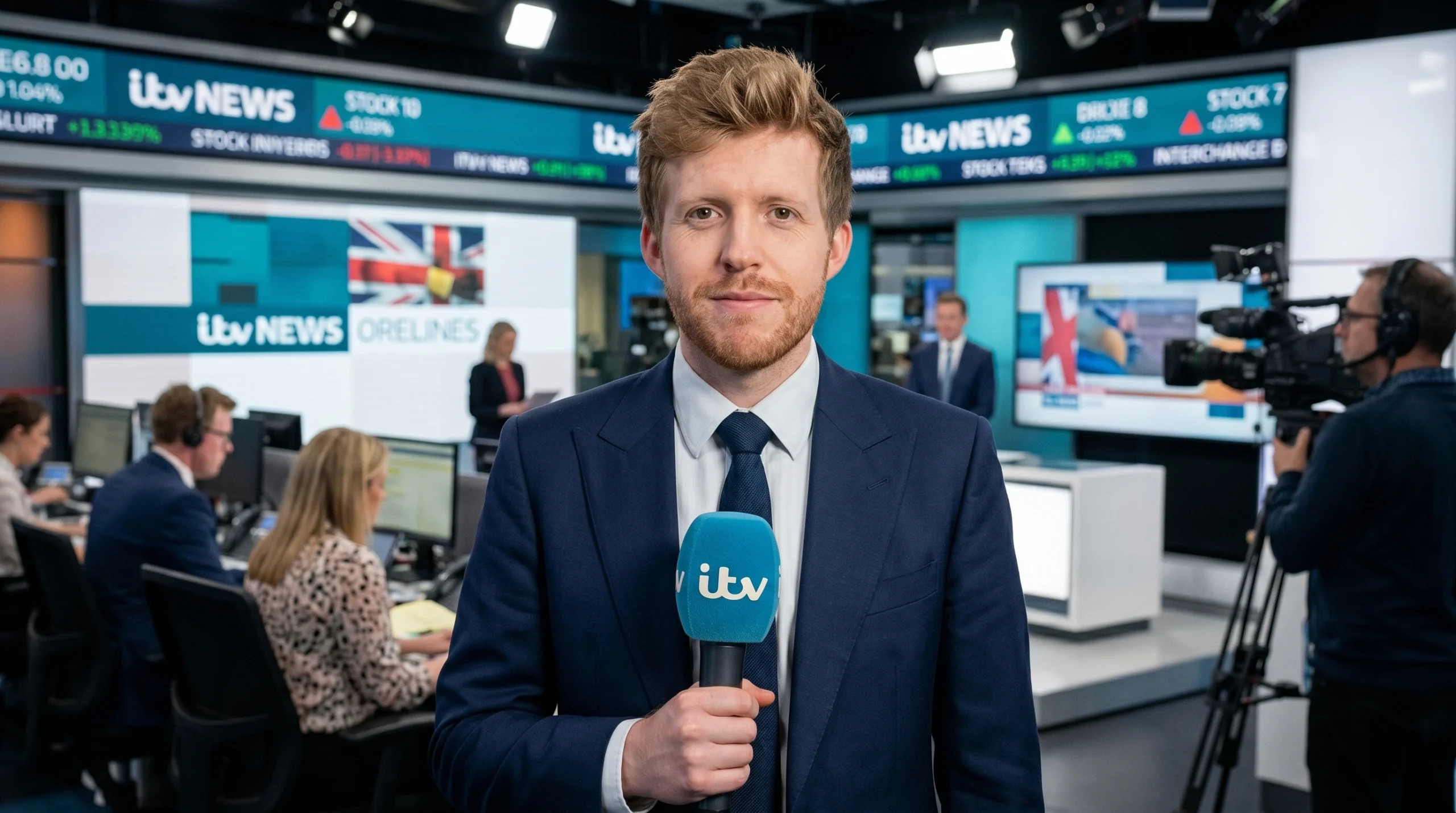
Fred Dimbleby carries a surname that many British viewers associate with authority, public service, and some of the defining broadcasts of the last century. Yet his own career belongs to a very different media age, one shaped by regional politics, digital journalism, campaign clips, online explainers, and the daily pressure of making public affairs understandable outside Westminster. He is best known as a journalist with ITV News, where he has worked across national and regional news and is publicly identified as a political correspondent for ITV News Calendar.
Readers often search for Fred Dimbleby because they want to know whether he is part of the famous Dimbleby broadcasting family. That curiosity is understandable, but it can also obscure the more useful story. Fred Dimbleby is not simply a name attached to a legacy; he is a working journalist whose public record shows a route through student journalism, ITV production, political reporting, and charity trusteeship.
His biography is still developing, and that matters. Unlike Richard Dimbleby, David Dimbleby, or Jonathan Dimbleby, he does not yet have decades of public interviews, memoir material, and institutional histories attached to his name. A fair account has to respect that limit while still explaining what is known, what is not publicly confirmed, and why his career has started to attract attention.
Early Life and Family Background
Fred Dimbleby’s public identity is closely tied to one of Britain’s most recognisable broadcasting families. The Dimbleby name became part of British public life through Richard Dimbleby, the BBC war correspondent, radio reporter, television presenter, and national broadcaster whose voice became associated with state occasions and major public events. Richard’s sons, David Dimbleby and Jonathan Dimbleby, later built their own long careers in broadcasting, politics, history, and current affairs.
Fred Dimbleby belongs to a later generation of that family, and public records list his full name as Frederick Thomas Jordan Dimbleby. He is connected with The Richard Dimbleby Cancer Fund, a charity created in memory of Richard Dimbleby after his death from cancer in 1965. The charity connection is more than a family footnote because it places Fred inside an institution built around public service, health information, and the continuing memory of his grandfather.
The details of Fred Dimbleby’s childhood are not widely documented in reliable public sources. That is not unusual for a journalist rather than an entertainer or elected official, and it would be irresponsible to fill those gaps with guesses. What can be said is that his family background exposed him to journalism not as an abstract career but as a lived tradition, with public communication, civic responsibility, and broadcast standards woven into the family’s public reputation.
The Dimbleby Name and Its Weight
Richard Dimbleby remains one of the great figures in British broadcasting history. He reported during the Second World War, became one of the BBC’s defining voices, and helped shape the grammar of British broadcast journalism. His reports from the liberation of Bergen-Belsen in 1945 remain among the most serious moments in the history of radio news.
David Dimbleby later became familiar to generations of viewers as the presenter of Question Time and the face of BBC election-night coverage for many years. Jonathan Dimbleby also became a major broadcaster, interviewer, author, and presenter, especially in current affairs and history. Together, they gave the family name a rare kind of continuity in British public life.
For Fred Dimbleby, that history is both an inheritance and a complication. A famous surname can make people pay attention, but it can also lead them to assume too much. The better way to understand him is to see the family legacy as background, then judge his own career through the work he has actually done.
Education and Student Journalism
Fred Dimbleby studied history at Keble College, Oxford, according to his public student journalism record. During his time at Oxford, he became involved with Cherwell, one of the university’s best-known student newspapers. Cherwell identifies him as having served as comment editor before becoming editor for Trinity Term 2018.
That student newsroom experience matters because it gives a clear early sign of his professional direction. Student journalism at Oxford can be unusually demanding, not only because of the university’s public profile but because campus stories often involve power, money, access, reputation, and institutions with long histories. For a young journalist, that is useful training in asking direct questions and turning internal disputes into readable public stories.
His Cherwell work covered a range of subjects rather than a single narrow beat. The archive attached to his name includes pieces connected with university life, sport, access, student politics, public figures, and media culture. That breadth would later make sense for someone working in political journalism, where the reporter has to move between policy, personality, voters, institutions, and everyday consequences.
Early Ambitions and Formative Influences
It would be easy to assume that Fred Dimbleby always intended to become a broadcaster because of his family name. The public record does not prove that, and it is better not to overstate what cannot be known. What it does show is that he chose writing, editing, and reporting early enough to take on senior responsibility at a student newspaper before moving into professional news.
History is also a telling subject for a future political journalist. A history degree does not make someone a reporter, but it can sharpen habits that good reporting requires: reading closely, weighing evidence, understanding institutions, and seeing present disputes in a longer frame. Political journalism often rewards those who can remember what politicians said before, how past promises ended, and why voters mistrust repeated claims.
The family influence is still hard to ignore. Growing up around a name associated with public affairs would likely have made journalism feel less distant than it does for most young people. But here’s the thing: access to a tradition is not the same as a career, and the actual work still has to be learned in newsrooms, edits, scripts, interviews, deadlines, and live reporting.
Joining ITV and Learning the Newsroom
Fred Dimbleby’s professional profile places him within ITV News, where he has worked in several roles. ITV has described him as having worked as a producer on its national news team in London and in its Washington DC bureau. Professional profiles also describe him as having worked as a reporter for ITV’s national news team.
Those details suggest a career built through the practical machinery of television news. Producers are often less visible to viewers than correspondents, but they are central to how stories are made. They research, shape scripts, organise material, coordinate with crews, prepare interviews, check facts, and help turn complex events into clear broadcasts.
Working in Washington DC would also have given him experience in a political environment where British and American news priorities meet. A foreign bureau can be a fast education in speed, accuracy, diplomacy, and context. For a journalist moving toward politics, time in Washington offers exposure to campaigns, institutions, international relations, and the way domestic decisions can carry global consequences.
ITV News Calendar and Regional Political Reporting
Fred Dimbleby is publicly known for his work with ITV News Calendar, ITV’s regional news service covering Yorkshire and Lincolnshire. His role as a political correspondent places him at the meeting point of Westminster politics and local reality. That is a demanding space because national policy often sounds tidy in speeches and becomes far messier when it reaches towns, councils, businesses, hospitals, rail stations, farms, and households.
Regional political journalism is sometimes treated as a smaller stage than national politics, but that view misses the point. In places such as Yorkshire and Lincolnshire, political stories can reveal whether national promises are landing at all. Transport investment, devolution, farming policy, energy costs, local elections, public services, and party realignment all become more concrete when reported from outside the capital.
Dimbleby’s ITV work has been associated with topics such as elections, party campaigning, Reform UK, Northern Powerhouse Rail, assisted dying, pensions, infrastructure, and cost pressures. These are not soft assignments. They require a reporter to understand both the national argument and the local consequences, then explain them without drowning viewers in Westminster language.
Covering Politics in a Volatile Period
Fred Dimbleby’s political reporting has unfolded during a period of sharp change in British politics. The old party map has become less predictable in many parts of England, and voters who once seemed loyal to one party have become more willing to shift. Yorkshire and Lincolnshire offer strong examples of that volatility, with local concerns often intersecting with national frustration.
Reporting on Reform UK during the 2024 general election campaign placed Dimbleby near one of the most closely watched stories in British politics. Reform’s rise placed pressure on the Conservative Party, complicated Labour’s electoral strategy, and gave regional reporters plenty to test on the ground. Campaign reporting in that context requires more than repeating party claims; it requires listening to voters, checking local support, and explaining what the movement means in specific constituencies.
His work on regional politics also reflects a broader truth about British journalism. The most revealing political stories are not always found in Westminster corridors. Often, they are found in places where voters explain what they think has failed, what they no longer believe, and what they want from leaders who appear on television but rarely seem close to everyday life.
Public Image and Reporting Style
Fred Dimbleby’s public image is still modest compared with the older members of his family. He is not a celebrity presenter with decades of prime-time exposure, and he has not built his career around personality-led broadcasting. His profile is closer to that of a serious working correspondent whose reputation is attached to accuracy, clarity, and the subjects he covers.
That lower-key public image may work in his favour. Political journalism already suffers from too much performance, and regional viewers often respond better to reporters who sound grounded rather than grand. Dimbleby’s role requires him to be visible enough to explain the story, but not so visible that he becomes the story.
The Dimbleby surname inevitably shapes how some viewers see him. Some will bring admiration for the family’s broadcasting history; others may bring scepticism about media dynasties and inherited opportunity. The fair test is the public one: whether his reporting is clear, properly sourced, and useful to the audience it serves.
Charity Work and The Richard Dimbleby Cancer Fund
Fred Dimbleby is a trustee of The Richard Dimbleby Cancer Fund, the charity established in memory of his grandfather. Public charity records list Frederick Thomas Jordan Dimbleby among the trustees, and the charity’s own materials identify Fred Dimbleby as having joined the board in 2019. His involvement gives his public life a second strand beyond journalism.
The fund’s work has evolved over time, with a strong focus on helping people affected by cancer find support. One of its major projects is Cancer Care Map, an online service designed to help people locate cancer care and support services across the United Kingdom. That digital emphasis fits naturally with Fred Dimbleby’s background in online and broadcast journalism.
Charity trusteeship is not the same as celebrity patronage. Trustees have legal and practical responsibilities for governance, oversight, and the charity’s direction. For Dimbleby, the role connects family memory, public service, and modern digital information in a way that feels consistent with both the Dimbleby legacy and his own professional skills.
Private Life, Relationships, and Public Boundaries
Fred Dimbleby has not made his private life a major part of his public profile. There is no widely established public record confirming a marriage, children, or long-term relationship in the way such details are documented for many entertainment figures or senior public officials. Because of that, any biography should avoid turning search curiosity into unsupported personal claims.
That restraint is especially important for journalists, who often appear in public because of their work rather than because they have chosen a celebrity life. Viewers may recognise a correspondent’s face or name, but that does not mean the person’s family life is public property. In Dimbleby’s case, the reliable public material is strongest around his education, career, charity role, and family broadcasting background.
The same caution applies to his exact age, income, and household details. Some online pages may offer estimates or claims, but estimates are not facts unless they rest on clear evidence. The responsible approach is to say what is known and leave private matters private unless they have been confirmed by credible public sources.
Net Worth and Income Sources
There is no credible, independently verified public estimate of Fred Dimbleby’s net worth. Unlike actors, founders, or senior executives, working journalists rarely have detailed public financial records unless they hold major corporate roles, publish declared outside income, or become public officeholders. Claims about exact net worth figures should therefore be treated with caution.
His likely income sources are straightforward but private. They would include salary or fees connected with journalism work, and possibly other professional media work if publicly disclosed. His charity trusteeship should not be assumed to be a source of personal wealth, and charity governance roles are often unpaid or limited in expenses depending on the organisation’s rules.
A biography that invents a money figure would mislead readers. The most accurate statement is that Fred Dimbleby’s net worth is not publicly verified. His professional standing is better measured through his newsroom roles, public bylines, reporting responsibilities, and trusteeship rather than speculative financial rankings.
Setbacks, Controversies, and Public Scrutiny
There are no major well-documented public controversies attached to Fred Dimbleby in the reliable public record. That does not mean his work avoids scrutiny, because political reporting always attracts criticism from viewers with strong views. It does mean there is no sound basis for presenting scandal, conflict, or personal setback as a defining part of his biography.
The main scrutiny around him is structural rather than personal. Some readers may question whether a famous media surname gives a young journalist advantages that others lack. That question is fair in a broader discussion about class, access, and media recruitment in Britain, but it should be handled carefully rather than aimed as a personal accusation without evidence.
British journalism has long had problems with narrow pathways into top roles, including unpaid work, elite universities, family connections, and London-based networks. Fred Dimbleby’s background may invite that wider conversation, especially because he studied at Oxford and comes from a famous broadcasting family. Still, his public career should be assessed through the reporting record as well as the privilege that may have shaped opportunity.
Why Fred Dimbleby Matters
Fred Dimbleby matters because he represents a newer generation inside an old broadcasting story. The Dimbleby name belongs to the age of radio authority, national television rituals, and high-profile current affairs. Fred’s career belongs to an age of regional political reporting, digital distribution, search visibility, and a more fragmented public trust.
His work also matters because regional politics matters. The places covered by ITV Calendar are central to many of Britain’s biggest political questions: transport inequality, local government pressure, post-industrial change, farming, energy, housing, coastal economies, and changing party loyalties. A reporter working that beat has to explain not only what politicians say, but whether their promises mean anything in practice.
The best reason to pay attention to Fred Dimbleby is not simply that he is a Dimbleby. It is that his career shows how a familiar public name is being tested in a changed news system. The old family standard was authority; the modern test is whether journalism remains trusted, useful, and close enough to people’s lives.
Where Fred Dimbleby Is Now
Fred Dimbleby is currently known as a journalist with ITV News, with public profiles identifying him as a political correspondent for ITV News Calendar. His work places him in regular contact with regional political stories across Yorkshire and Lincolnshire. That position gives him a public platform without making him a celebrity in the usual entertainment sense.
He also continues to be publicly associated with The Richard Dimbleby Cancer Fund as a trustee. That role links him to a family charity with a long history and a modern digital mission. It is one of the clearest examples of how his public life connects the Dimbleby past with present-day communication.
His future career could move in several directions. He may remain a regional political specialist, move further into national political reporting, take on more presenting work, or continue developing across digital and broadcast formats. Whatever path he takes, the record so far suggests a journalist still in the earlier chapters of a career likely to draw more attention over time.
Frequently Asked Questions
Who is Fred Dimbleby?
Fred Dimbleby is a British journalist best known for his work with ITV News. He is publicly identified as a political correspondent for ITV News Calendar, covering politics across Yorkshire and Lincolnshire. His career has also included work with ITV’s national news team and experience connected with the broadcaster’s Washington DC bureau.
Is Fred Dimbleby related to Richard Dimbleby?
Yes, Fred Dimbleby is publicly connected to the Dimbleby broadcasting family and to The Richard Dimbleby Cancer Fund. Richard Dimbleby was one of Britain’s most important early broadcast journalists and the BBC’s first war correspondent. Fred’s charity trusteeship and family name place him within that wider legacy.
What is Fred Dimbleby’s full name?
Public charity records list him as Frederick Thomas Jordan Dimbleby. In his professional journalism and charity profiles, he is commonly referred to as Fred Dimbleby. That shorter name is the one most readers and viewers are likely to encounter.
Where did Fred Dimbleby study?
Fred Dimbleby studied history at Keble College, Oxford, according to his public student journalism profile. While at Oxford, he worked on Cherwell, the student newspaper, and became editor for Trinity Term 2018. That experience appears to have been an important early step in his journalism career.
What does Fred Dimbleby report on?
Fred Dimbleby reports mainly on politics, especially through the lens of Yorkshire and Lincolnshire. His public work has been linked with elections, party campaigning, infrastructure, public services, assisted dying, pensions, and the local effects of national policy. His beat requires him to connect Westminster arguments with regional consequences.
Is Fred Dimbleby married?
There is no widely confirmed public information establishing Fred Dimbleby’s marital status. He has kept his private life largely outside his professional profile. Because of that, claims about marriage, children, or relationships should not be treated as fact unless they come from reliable public sources.
What is Fred Dimbleby’s net worth?
Fred Dimbleby’s net worth is not publicly verified. Online estimates should be treated carefully because they often lack sourcing and may be based on guesswork. His known professional life centres on journalism and charity trusteeship rather than publicly disclosed business holdings or celebrity income.
Conclusion
Fred Dimbleby’s story is still being written, which makes precision more important, not less. The confirmed picture is of a journalist shaped by student reporting, ITV newsroom experience, regional political coverage, and a family tradition deeply tied to British broadcasting. That is enough to make him interesting without overstating what the public record can prove.
The surname will always attract attention. For some readers, it will evoke Richard Dimbleby’s wartime authority or David Dimbleby’s election-night presence. For Fred Dimbleby, the challenge is different: to build trust in an age when audiences are scattered, sceptical, and quick to judge the media.
What makes his career worth watching is the meeting of old legacy and new pressure. He works in a field where facts still matter, but so do speed, clarity, and local understanding. If his next chapters continue in political journalism, his reputation will depend less on the famous name he inherited and more on the public value of the work he puts on the record.
