

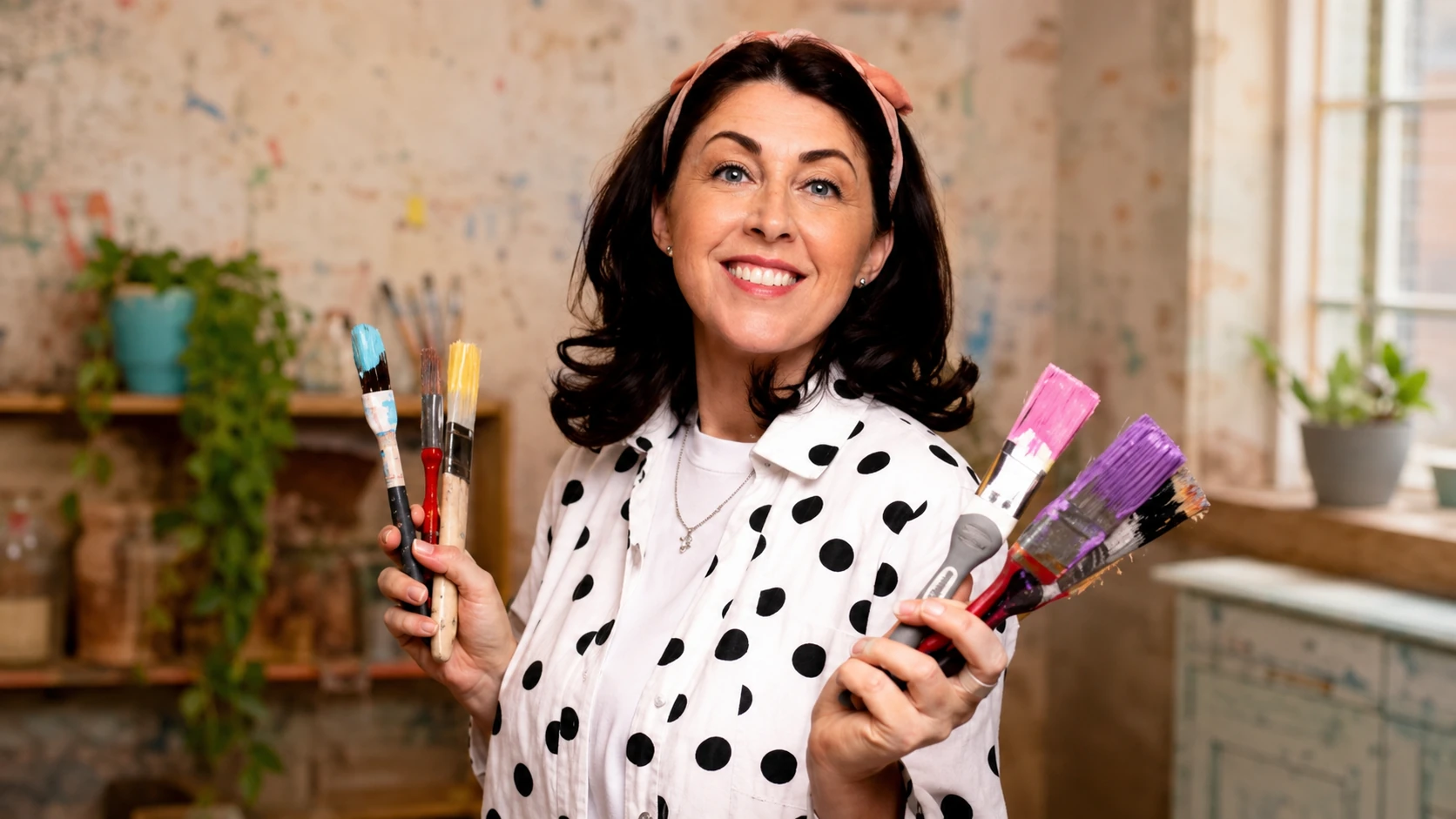
Gemma Longworth’s public story begins with objects most people would walk past: a tired cabinet, a scratched table, a box of buttons, a chair that has lost its place in a room. On screen, she is the Liverpool upcycler viewers know from Find It, Fix It, Flog It, the Channel 4 restoration series built around turning forgotten things into useful, sellable pieces again. Away from television, her work has always carried a deeper current. Longworth has used art, craft, textiles, and furniture repair not only as design tools, but also as ways to help people process loss, build confidence, and reconnect with themselves.
That is why her biography cannot be told only as a television profile. She is a British artist, furniture restorer, presenter, workshop leader, business founder, author, and community creative whose career grew out of Liverpool’s art scene and hospital-based craft work. Her name is searched by people who want to know her age, family background, husband, net worth, career path, and current projects, but the most reliable public picture is centered on her work rather than her private life. The facts show a woman who built a career from making, teaching, repairing, and helping others see worth in things that might otherwise be thrown away.
Early Life and Family Background
Gemma Longworth is closely associated with Liverpool, the city that shaped both her creative identity and her public work. She has been described in local coverage as Liverpudlian and Anfield-born, and many of her projects have remained rooted in Merseyside. That local grounding matters because her work has never felt detached from community life. Even after television expanded her audience, she continued to work with charities, hospitals, creative groups, and local venues.
One of the most meaningful publicly known details about Longworth’s early life is the loss of her younger brother. She has spoken and written about how his death affected her, and how drawing became a way of keeping a connection with him. Her brother loved to draw, and after losing him, she began making art in his memory. That experience later helped shape her belief that creativity can become a gentle language for grief.
Longworth has not made every part of her family life public, and that boundary should be respected. Reliable profiles focus on her creative background, education, television career, hospital work, and community projects. They do not provide a full public account of her parents, siblings beyond the brother she has discussed, or wider family relationships. For that reason, any claims that go beyond what she has shared publicly should be treated carefully.
Education and First Creative Ambitions
Longworth’s formal creative education began in Liverpool. She attended the City of Liverpool College from the age of 17, studying art and design before moving through further creative training. Her early path suggests a young artist who was drawn not just to making attractive things, but to understanding texture, form, colour, material, and the emotional charge that handmade objects can carry. That foundation later became visible in her furniture work and workshop teaching.
After her studies in Liverpool, she went on to study Drawing and Applied Arts in Bristol. She later completed a master’s degree in Textiles in Manchester, deepening her connection to fabric, surface, craft process, and mixed-media work. Her postgraduate direction also included interest in art as a therapeutic tool. That thread would become one of the most consistent parts of her public career.
Her education gave her technical skills, but her early working life was not a straight line into success. Like many creative graduates, she faced the difficult question of how to turn training into paid work. Instead of waiting for a ready-made job to appear, she began creating her own route. That decision became central to the Gemma Longworth story: she built opportunities through workshops, volunteering, local networks, and practical persistence.
Alder Hey, Bereavement Work and the Healing Side of Craft
Before she became familiar to television viewers, Longworth was already using art in settings where creativity had a serious purpose. She volunteered at Alder Hey Children’s Hospital, running arts and crafts workshops with children and families. That work was not simply entertainment or distraction. It gave children a way to make, play, communicate, and express feelings that may not have been easy to put into words.
Her later public profile has repeatedly connected her to bereavement support and therapeutic art. She has worked with children dealing with loss, creating resources and sessions built around creative expression. This is a key part of her story because it explains why her craft work often feels warmer and more personal than a standard makeover brand. For Longworth, making something is not only about the finished item; it is also about the state of mind created while making it.
This background also gives her television work a different meaning. On Find It, Fix It, Flog It, the task is usually practical: restore, repurpose, and improve an object. But Longworth’s wider career shows that she thinks about repair more broadly. A broken, forgotten, or outdated item can become useful again, and a person who is grieving or uncertain can also find small steps forward through creative activity.
The Button Boutique and Building a Career From Scratch
Longworth’s early business breakthrough came through The Button Boutique, a creative project she launched after struggling to find the kind of work she wanted. The business grew from her love of vintage buttons, beads, textiles, handmade objects, and craft workshops. It also grew from the demand created by the sessions she had begun in hospitals and local community spaces. What started as a practical response to limited opportunities became a platform for her creative identity.
The Button Boutique offered workshops, parties, craft sessions, and handmade work. Its name reflected Longworth’s affection for small, tactile, often overlooked materials. Buttons are humble objects, but they carry memory: old coats, children’s clothes, family sewing boxes, and practical acts of mending. That symbolism fits much of Longworth’s later work, where the small and ordinary are often treated with care.
The business also connected her to Liverpool’s creative economy. She rented workspace, ran sessions, built a local audience, and developed the teaching style that would later serve her well on television and in public events. The Button Boutique Limited was later dissolved, so it should be seen as an important earlier chapter rather than her current business identity. Still, it remains one of the clearest examples of how she created work when a conventional career path did not open quickly.
Career Breakthrough on Find It, Fix It, Flog It
Gemma Longworth became widely known through Find It, Fix It, Flog It, the Channel 4 programme that turns unwanted household, workshop, and garage finds into restored or repurposed pieces. The show is fronted by figures including Henry Cole and Simon O’Brien, with practical restorers and upcyclers helping bring the ideas to life. Longworth joined the programme as a furniture restorer and creative maker, bringing colour, textiles, paintwork, and design judgment to objects that often arrived in poor condition.
Her role suited her background perfectly. She was not simply decorating furniture; she was reading the object, judging what could be saved, and deciding how to make it appealing again. Viewers responded to the directness of that work because the transformation was visible. A neglected chair, table, cabinet, or odd piece of salvage could be made into something with charm, use, and value.
The show also gave Longworth a national audience without stripping away her local identity. She remained recognisably Liverpool-based, practical, warm, and hands-on. That mix helped her stand apart from more polished design personalities. She came across as someone who could teach a workshop, paint a cabinet, talk through a repair, and make viewers feel that they might be able to try the same thing at home.
Her Upcycling Style and Creative Method
Longworth’s upcycling style is rooted in colour, surface, texture, and emotional accessibility. She has described herself as a furniture painter and upcycler, and her work often involves paint finishes, stencilling, fabric choices, gold leaf, and decorative detail. She has also made clear that she adjusts her style depending on the project. A piece made for her own taste can be bolder, while a piece made for television or resale may need wider appeal.
That judgment is one of the underrated skills in upcycling. It is easy to make something louder; it is harder to make it better. Longworth’s best work depends on knowing what to preserve, what to cover, and what the object can realistically become. A successful restoration does not erase the past completely. It gives the item a second life without making it feel false.
Her work also reflects a practical environmental argument. Upcycling keeps furniture and materials out of landfill, but it also challenges the habit of replacing things too quickly. A tired wardrobe may need sanding, paint, new handles, and imagination rather than disposal. A hotel room or home can feel refreshed without buying every piece new, and that idea has become more relevant as people think harder about waste, cost, and personal style.
Public Projects Beyond Television
Longworth’s public work has not stayed inside the television studio. She has taken on real-world upcycling projects in Liverpool, including hotel furniture, community spaces, and charity-linked makeovers. One reported project involved helping refresh the Sir Thomas Hotel in Liverpool by upcycling existing furniture rather than sending it to landfill. That kind of project shows how her television skills translate into practical design work for public spaces.
She has also worked with charities and community organisations, including projects that bring colour and craft into shared environments. A public example involved helping improve a coffee shop space connected to Mencap Liverpool and Sefton. Such work fits her wider pattern: take a tired or underused setting, involve people where possible, and create a more welcoming place through hands-on making. It is design with a community purpose rather than design for display alone.
These projects matter because they keep Longworth’s reputation grounded. Many television craftspeople build public recognition through screen work, but fewer maintain a clear connection to local workshops and charitable settings. Longworth’s career has been strongest where these worlds overlap. She can work for viewers, clients, participants, and people who need creative support, and the tone remains recognisably hers.
Hidden Gems and Community Creative Work
In recent years, Longworth’s work has increasingly been connected with Hidden Gems, a creative support service built around art, craft, wellbeing, bereavement support, and sustainability. Gemma’s Hidden Gems CIC was incorporated as a Community Interest Company in October 2024. That formal step is significant because a CIC is designed for organisations that operate with a community benefit purpose. It reflects the direction her work had already been moving in for years.
Hidden Gems offers workshops for children, adults, groups, events, charities, and one-to-one settings. Its work includes creative wellbeing sessions, bereavement support, sustainability workshops, team-building activities, and personalised art sessions. This is not far removed from Longworth’s earliest hospital craft work. In many ways, it looks like a fuller version of the same mission.
The name “Hidden Gems” also fits her creative philosophy. It suggests value waiting to be found, whether in a person, a memory, a chair, or a damaged object. That idea has followed Longworth from The Button Boutique to television and into community support. Her public career keeps returning to the same belief: people and things should not be written off too quickly.
Craft Your Cure and Becoming an Author
Longworth’s book Craft Your Cure: 25 craft and upcycling projects to heal and bring joy was published in 2025 by Watkins Publishing. The book gathers the ideas that have shaped much of her work: craft, grief, memory, colour, repair, upcycling, and emotional wellbeing. It includes practical projects such as paper crafts, cushions, mending, knitting, pottery-style making, doodling, and furniture repair. The title signals the personal nature of the work, but it also places creativity in a supportive rather than clinical frame.
The book draws from Longworth’s own experience of loss and her belief that making can help people through difficult periods. She has written publicly about how creativity became a lifeline after losing her brother. That does not mean craft removes grief or solves every emotional struggle. It means that creative work can give grief a place to go, especially when words are not enough.
Publishing the book also widened Longworth’s reach beyond workshops and television episodes. A viewer may see one restored item on screen, but a reader can spend time with her ideas and try the projects at home. That gives her work a more lasting form. It also strengthens her position as a creative wellbeing voice, not only as a furniture restorer.
Marriage, Children and Private Life
Many readers search for Gemma Longworth’s husband, partner, or children, but these details are not strongly confirmed in reliable public sources. Her professional biographies focus on her work, education, television, book, and creative support projects. She has chosen to share parts of her grief story, especially the loss of her younger brother, but that does not mean every personal relationship is public. A responsible profile should not fill that space with guesses.
This privacy is not unusual for people who become known through craft and factual television. Longworth is visible because of her skills and public projects, not because she has made her personal life the center of her brand. That creates a natural limit for biography writers. The public can know her work well while still knowing only selected parts of her family life.
For readers, the most accurate answer is simple. Gemma Longworth has not made a widely verified public record of a husband, spouse, or children central to her professional profile. If that changes through a confirmed interview or official biography, it can be reported. Until then, her private life should be treated as private.
Net Worth, Business Interests and Income Sources
There is no credible confirmed net worth figure for Gemma Longworth. Some online pages may offer estimates, but these numbers are usually unsupported and should not be treated as fact. Her known income sources are easier to identify than her total wealth. They likely include television work, creative workshops, public appearances, commissions, book royalties, project fees, and community arts work.
Her earlier business, The Button Boutique Limited, is part of her public business history, but it is no longer an active company. Her more recent formal project, Gemma’s Hidden Gems CIC, reflects a community-focused structure rather than a standard private company built only for profit. That distinction matters because a CIC is meant to serve a public or community benefit. It does not support simple assumptions about personal wealth.
The honest conclusion is that Longworth has built a varied creative career, not a publicly documented fortune. Her value is better measured through the reach of her work and the number of settings in which she has applied it. Television gave her recognition, but workshops, community projects, and publishing show the range of her professional life. Any exact net worth claim should be treated as an estimate unless backed by reliable financial records.
Public Image and Industry Standing
Gemma Longworth’s public image is unusually consistent. She is seen as warm, practical, creative, and approachable, with a style that encourages people to try rather than simply admire. That makes her different from design figures whose work feels too expensive or polished for ordinary viewers. Longworth’s appeal lies in showing that transformation can begin with an old object, some tools, a bit of patience, and a willingness to make mistakes.
Her standing also comes from the fact that she combines skill with purpose. Many people can repaint furniture, but fewer connect that work to grief support, community confidence, sustainability, and hospital-based creative care. That combination gives her public work more depth. It allows her to speak to viewers who enjoy home improvement and to people looking for gentler ways to manage difficult emotions.
She has not built her name on controversy. Her profile has grown through service, craft, teaching, and television visibility. That quieter form of public recognition may not create constant headlines, but it often builds stronger trust. Viewers and workshop participants can understand what she does and why it matters.
Where Gemma Longworth Is Now
Gemma Longworth’s current public work appears centered on Hidden Gems, creative wellbeing, upcycling, workshops, and her book Craft Your Cure. She remains associated with Find It, Fix It, Flog It, which continues to give her a television identity. At the same time, her more recent work shows a clear move toward structured community support through art and craft. That balance between screen work and hands-on support is central to her current profile.
Her 2025 book has also given her a stronger author identity. It brings together the personal and practical sides of her career in a way that a television segment cannot fully capture. For readers who know her only from furniture transformations, the book helps explain the emotional roots of her work. For people who know her through wellbeing projects, it provides practical ways to make creativity part of daily life.
Longworth’s story is still active rather than closed. Hidden Gems is a recent formal venture, and her work sits in areas that continue to grow: reuse, sustainability, craft therapy, community wellbeing, and accessible design. She occupies a space where television visibility can support real-world work. That makes her current chapter one of the most interesting parts of her biography.
Frequently Asked Questions
Who is Gemma Longworth?
Gemma Longworth is a British artist, furniture upcycler, television presenter, workshop leader, and author from Liverpool. She is best known for her work on Channel 4’s Find It, Fix It, Flog It, where she restores and repurposes unwanted furniture and objects. Her wider career includes hospital craft work, bereavement support, community workshops, Hidden Gems, and the 2025 book Craft Your Cure.
How old is Gemma Longworth?
Public company records list Gemma Longworth’s birth month and year as May 1984. That means she is around 41 or 42 in May 2026, depending on the exact date of birth. Because the full date is not usually central to her public biography, careful profiles should avoid giving an exact birthday unless it is confirmed by a reliable source.
Where is Gemma Longworth from?
Gemma Longworth is strongly associated with Liverpool and has been described in local coverage as Liverpudlian and Anfield-born. She studied in Liverpool before continuing her creative education in Bristol and Manchester. Much of her work has remained connected to Merseyside through hospitals, charities, workshops, and local creative projects.
Is Gemma Longworth married?
There is no widely confirmed reliable public information about Gemma Longworth’s marital status. Her professional profiles focus on her creative work rather than a husband, partner, or children. Because of that, claims about her marriage or private relationships should be treated carefully unless they come from a confirmed interview or official source.
What is Gemma Longworth’s net worth?
Gemma Longworth’s net worth has not been confirmed by a reliable public source. Her known income-related work includes television, workshops, creative commissions, public events, book publishing, and community arts projects. Any exact net worth figure online should be viewed as an estimate rather than a verified fact.
What is Gemma Longworth’s book called?
Gemma Longworth’s book is called Craft Your Cure: 25 craft and upcycling projects to heal and bring joy. It was published in 2025 and combines craft projects with her personal belief in creativity as a source of comfort and connection. The book reflects her long-standing interest in art, grief support, repair, and wellbeing.
What is Hidden Gems?
Hidden Gems is Gemma Longworth’s creative support project focused on art, craft, wellbeing, bereavement support, sustainability, and community workshops. Gemma’s Hidden Gems CIC was incorporated as a Community Interest Company in October 2024. The project reflects the direction her work has taken beyond television, with a stronger focus on helping people through creative activity.
Conclusion
Gemma Longworth’s biography is not simply the story of a television upcycler who became familiar to Channel 4 viewers. It is the story of an artist who turned personal loss, formal training, local opportunity, and practical craft into a public career. Her work has moved through hospitals, workshops, furniture restorations, television sets, community spaces, and now a published book.
What makes her stand out is the consistency of the idea behind the work. Whether she is repainting a cabinet, teaching a group, supporting bereaved children, or writing about craft, Longworth returns to the same belief in repair. Objects can be renewed, rooms can be warmed, and people can sometimes find steadier ground through the act of making.
Her private life remains mostly private, and that should not weaken the public story. The confirmed record is already rich enough: Liverpool roots, creative education, The Button Boutique, Alder Hey, Find It, Fix It, Flog It, Hidden Gems, and Craft Your Cure. Together, those chapters show a career built not on spectacle, but on usefulness, care, and the quiet satisfaction of turning something overlooked into something valued again.
