

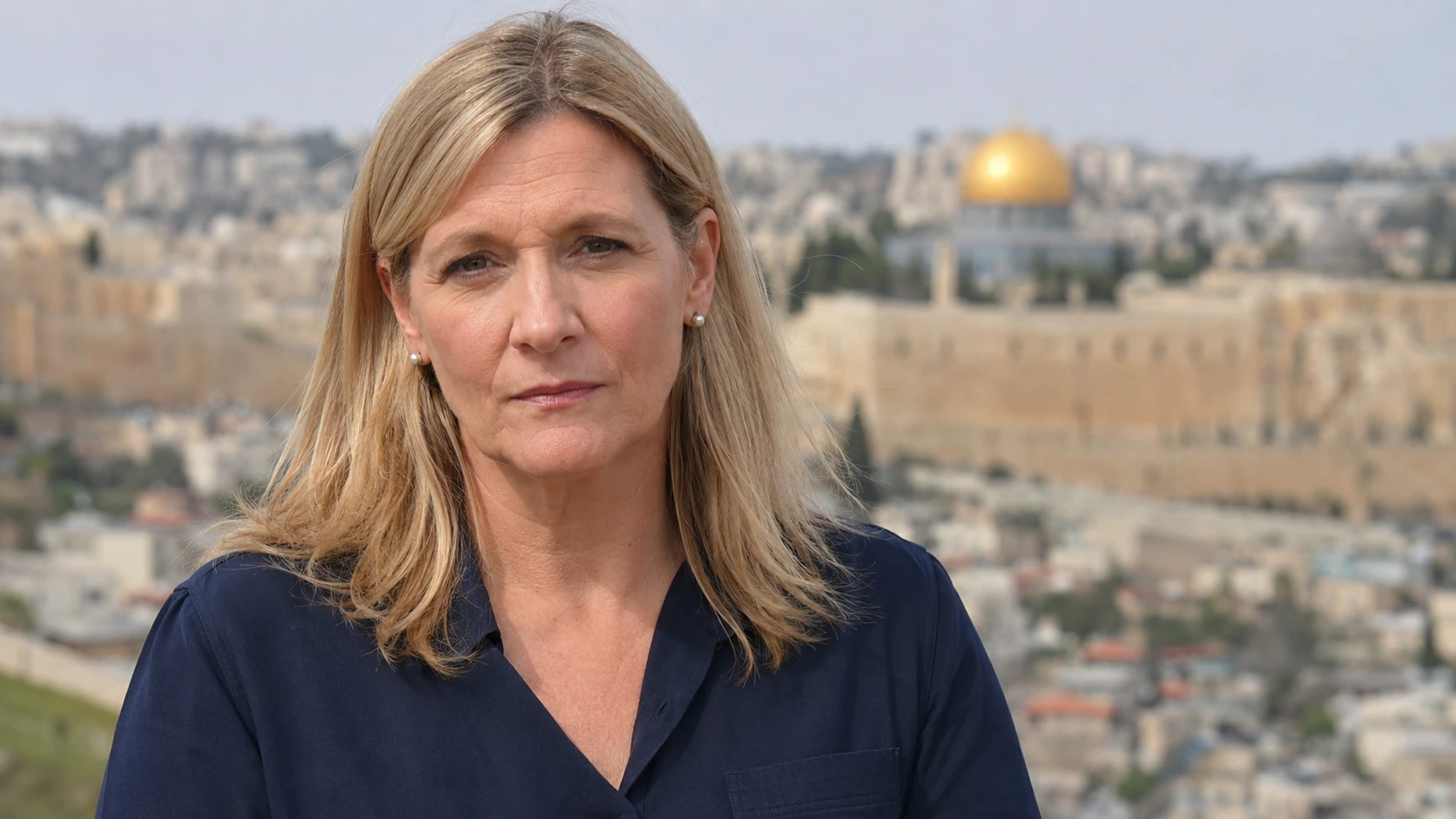
For many international news viewers, Yolande Knell is a familiar presence during moments of crisis. Her reporting has appeared during wars in Gaza, political upheaval in Egypt, violence in Jerusalem, and humanitarian emergencies across the Middle East. She is one of the BBC journalists most closely associated with explaining one of the world’s most difficult and emotionally charged regions to a global audience.
Unlike celebrities or television personalities who build public profiles through personal branding, Knell has remained largely defined by her work. Viewers searching for “Yolande Knell” are usually trying to understand the journalist behind the byline: where she came from, how she built her career, what she has covered, and why her reporting appears so often during major world events. The public record offers far more information about her journalism than her private life, and that balance has shaped the way audiences understand her.
Over the years, Knell has become associated with careful field reporting from Israel, the Palestinian territories, Egypt, Jordan, and neighboring parts of the region. Her work has involved not only politics and conflict, but also ordinary civilian life during extraordinary times. That combination has helped her stand out in modern broadcast journalism, where foreign correspondents often face pressure to move quickly while still remaining accurate and measured.
Early Life and Education
Publicly available information about Yolande Knell’s early life remains relatively limited compared with many media personalities. She has not turned her upbringing into part of her public identity, and the BBC itself focuses far more on her journalism than on biographical details. That has left some online searches filled with speculation, especially around her age, family background, and personal relationships.
What is clear is that Knell developed a strong interest in international affairs and reporting early in her professional life. Her later career suggests a journalist drawn toward foreign correspondence rather than domestic celebrity broadcasting. That path usually demands a different temperament: patience, adaptability, language skills, historical awareness, and a willingness to spend long periods in unstable environments.
Foreign correspondents covering the Middle East often arrive there after years of general reporting experience. The region demands deep political understanding and an ability to explain complicated history in clear language. Knell’s later reporting showed those qualities repeatedly, especially during fast-moving events where audiences needed context rather than dramatic commentary.
While some online biography sites claim specific educational details, not all of those claims are independently verified. Reliable public information about her academic background is surprisingly modest, which is not unusual for reporters whose careers developed through newsroom experience rather than public self-promotion.
Building a Career in Journalism
Before becoming widely recognized as a BBC Middle East correspondent, Knell worked through the demanding structure of international journalism. Reporters covering foreign affairs rarely become prominent overnight. Most spend years learning how to report accurately under pressure, gather information from conflicting sources, and explain unfamiliar political systems to broad audiences.
Knell’s professional reputation developed gradually through consistent field reporting. Her bylines appeared across BBC News coverage connected to Egypt, Israel, the Palestinian territories, and wider regional developments. As political unrest spread through the Middle East during the late 2000s and early 2010s, journalists with strong regional knowledge became increasingly important to international broadcasters.
One of the earliest widely referenced examples of her reporting involved Egypt. During that period, the country was moving through political instability that drew global attention. Knell covered developments connected to the Mubarak era and the turbulent years that followed. Those stories placed her in the middle of one of the defining international news cycles of the early twenty-first century.
Her reporting style helped distinguish her from more theatrical television personalities. Rather than relying heavily on dramatic delivery, Knell often focused on clear explanation and direct observation. That approach worked particularly well in stories involving humanitarian conditions, civilian displacement, and contested political narratives.
Reporting During the Arab Spring
The Arab Spring transformed the careers of many Middle East correspondents, and Yolande Knell was among the journalists reporting through that period of upheaval. Beginning in late 2010 and spreading across several countries, the protests reshaped political systems and drew unprecedented international media attention.
Egypt became one of the central stories of the movement. Demonstrations in Cairo’s Tahrir Square captured worldwide attention as protesters demanded political change. Journalists covering the events faced unstable conditions, shifting security situations, and governments attempting to control information. Correspondents had to move carefully while still delivering accurate reports quickly.
Knell’s reporting during this period contributed to her growing recognition within BBC international coverage. Her work reflected not only political developments but also the daily uncertainty experienced by ordinary civilians. That balance between political analysis and human stories became one of the defining features of her journalism.
The Arab Spring years also reshaped how audiences consumed foreign reporting. Social media accelerated the spread of footage and rumors, often faster than journalists could verify information. Correspondents like Knell had to work in an environment where misinformation circulated rapidly and pressure for instant updates was intense.
Becoming a BBC Middle East Correspondent
As her career progressed, Knell became strongly associated with the BBC’s Middle East coverage. Her reporting regularly emerged from Jerusalem, Bethlehem, Gaza-related developments, and other politically sensitive areas. Over time, viewers came to recognize her voice and reporting style during major international events.
The role of a Middle East correspondent involves far more than appearing on television during breaking news. Correspondents spend large portions of their time building contacts, understanding local politics, monitoring security developments, and gathering information from multiple sides of deeply contested stories. Trust becomes essential, especially in places where misinformation and propaganda are common.
Knell’s work frequently focused on how political decisions affected everyday life. One report might examine ceasefire negotiations, while another explored shortages of medical supplies or the experiences of displaced families. That reporting approach helped audiences connect broad geopolitical events with real human consequences.
What’s surprising is how much of foreign correspondence involves explaining context rather than reporting explosions or dramatic headlines. Audiences often encounter Middle East stories during moments of violence, but journalists working there spend much of their time explaining history, law, religion, diplomacy, and competing national narratives. Knell became known for that explanatory role.
Coverage of Israel and the Palestinian Territories
Knell’s name became especially familiar during periods of heightened tension between Israel and the Palestinians. Her reports covered Israeli politics, military operations, ceasefire negotiations, humanitarian concerns in Gaza, and disputes involving Jerusalem and the West Bank.
This beat remains one of the hardest assignments in international journalism. Every phrase used by reporters can trigger criticism from multiple directions. Words describing armed groups, civilian casualties, occupation, settlements, hostages, or military operations are heavily scrutinized by audiences, activists, governments, and media watchdogs.
Knell’s reporting has often attempted to present both the political and human dimensions of the conflict. She has reported on Israeli families affected by violence as well as Palestinian civilians living through war and displacement. That balancing act is central to BBC editorial standards, though it also means correspondents frequently face criticism from opposing political perspectives.
The truth is, no major international broadcaster escapes criticism on Israel-Palestine coverage. Some viewers believe the BBC is too critical of Israel, while others argue it softens Israeli government actions or underreports Palestinian suffering. Correspondents working on the ground inevitably become part of those larger debates.
Journalism Under Pressure
Foreign reporting from the Middle East carries serious personal and professional pressure. Journalists must operate in environments where security conditions can change quickly, information is contested, and emotional trauma is constant. Reporters covering war zones are expected to remain calm and accurate even when witnessing deeply distressing scenes.
Knell’s work has often unfolded against that backdrop. Whether reporting on military escalation, civilian displacement, or diplomatic negotiations, correspondents must constantly separate verified fact from rumor. The pace of modern news makes that task even harder, especially during active conflict.
The Gaza war after October 2023 intensified global attention on foreign correspondents. International audiences searched constantly for updates, while governments, advocacy groups, and media critics closely analyzed wording and framing. BBC reporters became targets of criticism from multiple sides, including campaigns accusing the broadcaster of bias either for or against Israel.
That said, the scrutiny itself reflects the importance of the reporting. Audiences care deeply about how these stories are told because the consequences are real and immediate. Journalists like Knell operate inside an environment where accuracy carries unusual weight.
Public Image and Media Reputation
Unlike many television figures, Knell has maintained a relatively private public image. Her reputation rests mostly on professional credibility rather than celebrity culture. That has kept attention focused largely on her reporting rather than her personal lifestyle.
Search interest around her often includes questions about age, marriage, family life, or nationality. Yet reliable public information about those subjects remains limited. Some websites publish unverified claims, but many lack clear sourcing. Responsible reporting requires distinguishing confirmed facts from internet speculation.
Her professional reputation, however, is much easier to trace. Over the years, Knell has become recognized as one of the BBC journalists consistently assigned to major Middle East stories. Her work appears across BBC television, radio, and online reporting, especially during moments of international tension.
Not many people know this, but foreign correspondents often develop strong reputations within journalism circles even if the wider public knows relatively little about their personal lives. In many ways, that reflects the culture of international reporting, where the focus traditionally remains on the story rather than the reporter.
Criticism and Controversy
Any journalist covering Israel and Palestine for a major international broadcaster will face criticism. Knell has been criticized by groups and commentators from very different political positions. Some accuse the BBC of unfairness toward Israel, while others argue its reporting fails to reflect the full scale of Palestinian suffering.
Media watchdog organizations have published critiques of specific reports involving Knell’s work. Those criticisms often center on wording, framing, omitted context, or perceived imbalance. Yet the fact that criticism arrives from opposing directions also highlights how impossible it is to satisfy every audience in such a deeply polarized conflict.
The BBC itself has faced wider scrutiny over Middle East coverage in recent years. Debates over terminology, editorial standards, and documentary production have intensified during the Gaza war period. Correspondents working in the field inevitably become associated with those larger institutional arguments.
But here’s the thing. Criticism alone does not automatically prove poor journalism. Foreign reporting in conflict zones involves incomplete information, shifting events, and emotionally charged narratives. Strong reporting is usually judged over time through consistency, sourcing, corrections, and overall credibility rather than isolated social media reactions.
Private Life and Relationships
Publicly confirmed information about Yolande Knell’s private life is limited. There is no widely verified public record confirming details about marriage, children, or long-term relationships. Some websites make claims about her family status, but many of those claims appear unsupported by primary evidence.
That relative privacy is not unusual among foreign correspondents. Journalists covering politically sensitive regions often avoid extensive public exposure of family life for both practical and security reasons. Maintaining boundaries between professional reporting and personal identity can become especially important in conflict reporting.
Readers searching for information about Knell’s husband or children should understand the distinction between public curiosity and verified fact. Reliable reporting standards require caution where evidence is thin. The absence of public confirmation should not be treated as hidden scandal or mystery.
Her public identity remains tied overwhelmingly to her journalism. For most audiences, the work itself is what matters most.
Career Influence and Industry Standing
Within international journalism, long-serving foreign correspondents often become valued because of experience rather than celebrity. Knell’s reporting history across Egypt, Israel, Gaza, Jordan, and the Palestinian territories has given her a strong institutional role within BBC international coverage.
Foreign correspondence demands historical memory. Reporters who stay on a beat for years can explain how current events connect to earlier agreements, uprisings, elections, ceasefires, or military operations. Audiences benefit from that continuity because conflicts rarely emerge from nowhere.
Knell’s work also reflects a wider shift in international journalism toward explanatory reporting. Modern audiences face an overwhelming flow of information online, much of it unreliable or emotionally manipulative. Correspondents capable of calmly organizing complicated facts remain highly valuable.
The role has changed significantly over the past two decades. Earlier generations of foreign correspondents worked mainly for newspapers or scheduled television broadcasts. Today’s reporters operate across live television, online updates, social media clips, podcasts, and rapid digital publishing cycles. Journalists like Knell have had to adapt continuously while maintaining editorial standards.
Where Yolande Knell Is Now
Yolande Knell continues to work as a BBC Middle East correspondent, with her recent reporting connected heavily to Israel, Gaza, humanitarian conditions, ceasefire efforts, and political developments across the region. Her bylines continue appearing on BBC News reports tied to some of the most important international stories of recent years.
The ongoing instability in the Middle East means experienced correspondents remain central to global news coverage. Audiences searching for reliable updates often turn toward established international broadcasters during crises, particularly when misinformation spreads rapidly online.
Knell’s recent work has included stories about hostage families, aid distribution, displaced civilians, court disputes over media access, and political negotiations. Those subjects show how modern conflict reporting extends beyond battlefield coverage into law, diplomacy, public grief, and civilian survival.
Her career reflects a form of journalism that still matters deeply despite the speed and chaos of digital media. Careful field reporting, context, verification, and historical understanding remain essential during moments when public attention is intense and misinformation travels quickly.
Frequently Asked Questions
Who is Yolande Knell?
Yolande Knell is a BBC Middle East correspondent known for reporting on Israel, Gaza, the Palestinian territories, Egypt, and wider regional developments. She has appeared regularly across BBC television, radio, and online coverage during major international news events.
What is Yolande Knell known for?
She is best known for her field reporting from the Middle East, especially coverage involving Israel and Palestine. Her journalism often combines political reporting with stories about the civilian impact of conflict and humanitarian crises.
Is Yolande Knell married?
There is no publicly verified information confirming Yolande Knell’s marital status. Some online pages make claims about her personal life, but reliable reporting standards require caution when information is not clearly confirmed.
Where is Yolande Knell based?
Knell has been strongly associated with Jerusalem-based reporting for the BBC. Her work frequently involves coverage from Israel, the West Bank, Gaza-related developments, and neighboring parts of the Middle East.
Has Yolande Knell covered wars and conflicts?
Yes. Much of her career has involved reporting from politically unstable or conflict-affected regions, including coverage connected to the Arab Spring, Gaza conflicts, Israeli-Palestinian tensions, and wider Middle East developments.
Why does Yolande Knell face criticism?
Middle East reporting attracts intense scrutiny from audiences with sharply different political perspectives. Like many journalists covering Israel and Palestine, Knell has faced criticism from both pro-Israel and pro-Palestinian commentators who disagree with aspects of BBC coverage.
Does Yolande Knell have a verified net worth?
There is no reliable publicly confirmed figure for Yolande Knell’s net worth. While some celebrity-style websites publish estimates, those figures are often speculative and unsupported by verifiable financial information.
Conclusion
Yolande Knell has built her public reputation through persistence rather than celebrity. Her work places her in the middle of some of the hardest stories in international journalism, where accuracy, restraint, and context matter enormously. Viewers may not know every detail of her private life, but they recognize the role she plays when global events demand serious reporting.
Her career also reflects the continuing importance of foreign correspondence in a fragmented media age. Audiences still look for journalists who can explain conflict without reducing it to slogans or online outrage. That responsibility carries pressure, criticism, and constant scrutiny.
The Middle East remains one of the world’s most closely watched and misunderstood regions. Journalists like Knell work inside that tension every day, trying to gather facts in places where truth is often disputed and emotions run high. The work is demanding, and sometimes controversial, but it remains essential.
For readers searching “Yolande Knell,” the clearest answer is also the most accurate one. She is a seasoned BBC correspondent whose career has become tied to the difficult task of explaining conflict, politics, and human survival in one of the world’s most important regions.
