

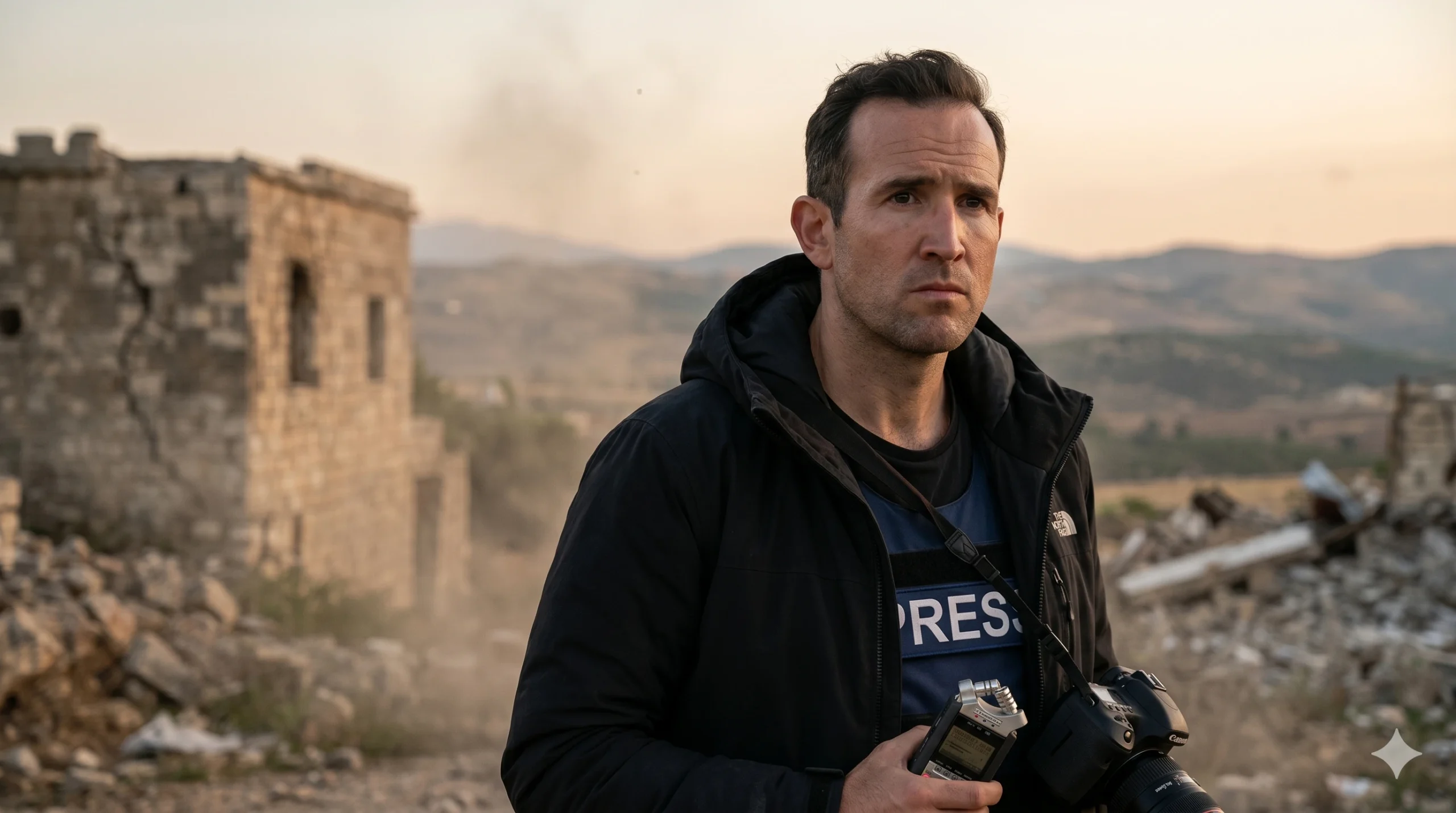
Hugo Bachega became familiar to many viewers in a moment no reporter would choose for himself. In October 2022, while reporting live from Kyiv for the BBC, explosions interrupted his broadcast as Russian strikes hit the Ukrainian capital. He stopped mid-sentence, listened, and moved to safety with the crew, turning a routine live cross into a stark reminder of what foreign reporting can demand.
That clip made his name more searchable, but it did not create his career. Bachega had already built the profile of a serious international journalist: calm on air, careful with language, and comfortable reporting from places where the facts move quickly and the consequences are immediate. His public work has centered on war, diplomacy, civilian displacement, and political crisis, especially in Ukraine, Lebanon, and the wider Middle East.
For readers searching “hugo bachega,” the interest is usually part curiosity and part trust check. People want to know who he is, where he comes from, whether he is married, how long he has been at the BBC, and what his background says about the stories he covers. The honest biography is clear on his public career but careful about his private life, because much of what circulates online about him has not been confirmed by strong public records.
Early Life and Background
Hugo Bachega is widely described in online profiles as having Brazilian roots, and several secondary accounts say he began his journalism career in São Paulo. That part of the story fits the professional path often associated with him, especially because Reuters, where he is frequently said to have worked early on, has a major news operation in Brazil. Still, the exact details of his birth date, hometown, parents, and childhood have not been publicly confirmed in a reliable official biography.
This matters because Bachega is not a celebrity who has built a public brand around personal disclosure. He is a working journalist whose visibility comes from reporting assignments, not from memoirs, lifestyle interviews, or entertainment coverage. As a result, the public record tells us much more about where he has reported than about where he grew up.
The lack of verified family detail should not be treated as a mystery to solve through guessing. Many foreign correspondents keep their private lives separate from the job, partly for safety and partly because the work is the point. In Bachega’s case, the responsible version of his early biography is simple: his background is widely linked to Brazil, but the most reliable public evidence concerns his journalism career rather than his childhood.
Education and First Steps in Journalism
Bachega’s education history is not clearly documented in open, dependable sources. Some internet biographies give confident claims about schooling, degrees, or early ambitions, but those claims often appear without primary sourcing. A careful profile should not turn those fragments into fact just because readers expect a neat origin story.
What can be said is that his later career shows the habits of a reporter trained in fast, disciplined news environments. His work reflects a command of breaking-news structure, attribution, live explanation, and international context. Those are not decorative skills; they are the basic tools of a correspondent expected to report from unstable places where official claims can change by the hour.
The path into international journalism usually rewards language ability, speed, accuracy, and judgment under pressure. Bachega’s career suggests he developed those traits early enough to move from agency-style reporting into broadcast work for one of the world’s largest news organizations. That move is important because the BBC requires correspondents to do more than gather facts; they must make complicated events understandable to a broad public audience.
Reuters, São Paulo, and the Discipline of Agency Reporting
Several public profiles say Bachega worked for Reuters in São Paulo before joining the BBC. While the finer details of that period are not fully laid out in a public résumé, the association is widely repeated and consistent with the kind of reporter he later became. Wire-service journalism is a demanding school because it strips news writing down to speed, clarity, evidence, and restraint.
At Reuters, reporters are trained to serve many kinds of clients at once, from newspapers and broadcasters to financial terminals and digital publishers. That means the writing has to be clean, the sourcing has to be visible, and the language has to avoid emotional overreach. A reporter who comes through that culture often learns to be precise under pressure rather than showy on the page.
Those habits are easy to see in Bachega’s BBC work. He tends to focus on what has happened, who is claiming what, and what remains unknown. In conflict reporting, that approach matters because a correspondent is often standing between official narratives, eyewitness accounts, military statements, and the suffering of civilians who need to be described without being turned into symbols.
Joining the BBC and Becoming a Foreign Correspondent
Bachega’s public profile is now tied most closely to the BBC, where he has worked as a correspondent on major international stories. He has been identified in public journalist directories as a BBC correspondent and as a BBC Middle East correspondent. His bylines and broadcasts place him in the center of some of the most closely watched crises of the past several years.
The BBC correspondent role is both visible and heavily edited. Viewers may see one reporter speaking live from Beirut, Kyiv, or another location, but the final report usually involves producers, camera crews, editors, security advisers, translators, and local contacts. Bachega’s name appears on the work, yet the work itself belongs to the collaborative machinery of international news.
That structure does not reduce his responsibility. A correspondent still has to make live judgments about language, tone, emphasis, and uncertainty. Bachega’s reputation rests partly on being able to do that in places where the atmosphere is tense and the public consequences of a wrong word can be serious.
The Kyiv Broadcast That Made Him Widely Recognizable
On October 10, 2022, Bachega was reporting live from Kyiv when explosions were heard during his broadcast. The moment came during a wave of Russian strikes on Ukraine’s capital and other cities, after the attack on the Kerch Bridge linking Russia and occupied Crimea. As the blasts sounded, Bachega paused, looked away from the camera, and the broadcast was cut short as he and the crew moved to safety.
The clip circulated widely because it showed war reporting without the distance viewers often expect from television. Bachega was not describing danger from a studio or summarizing it after the fact. He was trying to report while the danger entered the frame, forcing the audience to confront the physical reality behind breaking-news language.
That moment did not make Bachega a war correspondent overnight, but it did make more people aware of him. It also placed him in a long line of journalists whose names become known because a live report briefly exposes the risk behind the work. The power of the clip came from its restraint: there was no performance, only recognition that safety had to come first.
Reporting Ukraine to a Global Audience
Bachega’s Ukraine reporting formed part of the BBC’s wider coverage of Russia’s full-scale invasion, one of the defining international stories of the 2020s. Ukraine required correspondents to explain military developments, civilian attacks, diplomatic pressure, energy infrastructure, refugee movement, and the daily strain on people living under threat. The challenge was not only to report what happened, but to help audiences understand why each event mattered.
For a global broadcaster, Ukraine was also a test of consistency. The story moved across fronts, capitals, alliances, and seasons, with bursts of attention followed by fatigue. Correspondents like Bachega helped keep the human and political stakes visible even as the war became part of the daily news cycle.
His Kyiv broadcast remains the most remembered public moment from that period, but it should be read as part of a broader assignment. The real work of conflict journalism is rarely one viral clip. It is the steady reporting before and after the clip, much of it done in difficult conditions and without the drama that makes social media pay attention.
Middle East Reporting and the Lebanon Beat
In recent years, Bachega has been closely associated with BBC reporting from the Middle East, especially Lebanon. His work has covered the conflict between Israel and Hezbollah, the fragile politics of Beirut, cross-border strikes, displaced communities, and ceasefire efforts that bring relief without settling the deeper crisis. The beat is difficult because every local event can carry regional meaning.
Lebanon is not only a place where events happen; it is a country shaped by overlapping pressures. Hezbollah is a Lebanese political and military force with deep ties to Iran, Israel views the group as a major security threat, and the Lebanese state often operates under severe economic and political strain. A correspondent working there has to explain immediate violence without flattening the country into a battlefield.
Bachega’s recent work from Lebanon has often focused on the civilian consequences of conflict. Reports from southern Lebanon and Beirut have dealt with emergency workers, families returning to damaged areas, communities loyal to Hezbollah, and the limits of ceasefire arrangements. This kind of reporting asks readers to hold several truths at once: armed groups matter, states matter, but civilians usually pay first.
Style, Strengths, and On-Air Presence
Bachega’s on-air style is measured rather than theatrical. He does not appear to build reports around himself, which is one reason viewers may know his face without knowing much about his biography. In a media culture full of personal branding, his public identity remains tied to the story he is covering.
That restraint can be a strength in conflict reporting. Audiences watching a correspondent in a dangerous place need clarity more than performance. A calm delivery helps viewers understand what is known, what is being claimed, and what cannot yet be confirmed.
His writing and broadcast work also show a preference for plain explanation. He often frames events through practical questions: who has been hit, who is claiming responsibility, what officials are saying, how civilians are affected, and what the next political pressure point may be. That structure gives his reports a grounded quality even when the subject is volatile.
Public Image and Why Viewers Search His Name
Bachega’s public image is unusual because it is built almost entirely from journalism rather than personal exposure. He is not known for celebrity interviews, social-media spectacle, or public feuds. Viewers search him because they have seen him report from consequential places and want to know the person behind the byline.
That curiosity has produced a small ecosystem of biography pages that try to answer questions about his nationality, age, marriage, salary, and net worth. Some of those pages repeat plausible claims, while others stretch thin information into confident statements. The problem is not curiosity itself; the problem is treating private or unsupported details as established fact.
A better way to understand Bachega is through the public record of his work. He is a BBC correspondent associated with major international coverage, especially Ukraine and the Middle East. That may not satisfy every search query, but it is far more reliable than pretending the internet has verified details it has only copied.
Family, Marriage, and Private Life
There is no strong public record confirming Hugo Bachega’s marital status, spouse, children, or close family details. Some online pages make claims about his personal life, but they tend to do so without dependable sourcing. For that reason, those claims should be treated with caution rather than repeated as biography.
This restraint is not a gap in the story; it is part of responsible profile writing. Journalists who cover conflict may have personal safety reasons for keeping family information out of public view. Even without that concern, a person’s private relationships are not public property simply because their name appears on television.
What readers can fairly say is that Bachega has kept his personal life separate from his professional role. His public identity is attached to reporting, not to domestic life or celebrity access. That boundary deserves respect, especially when the available evidence does not support more specific claims.
Net Worth, Salary, and Income Sources
There is no verified public figure for Hugo Bachega’s net worth. Online estimates sometimes appear on biography sites, but they are usually based on generic assumptions about journalist salaries rather than documented assets, contracts, or disclosures. Any precise number presented without evidence should be viewed as speculation.
His known income source is his journalism work, most visibly as a BBC correspondent. BBC pay structures can vary widely depending on role, seniority, contract status, location, and whether a person is a staff employee or works under another arrangement. Without a public pay disclosure specific to Bachega, it would be misleading to assign him a firm salary.
This is a case where honesty is more useful than a guess. Bachega is a recognized international correspondent, but recognition does not automatically translate into celebrity-level wealth. His professional standing is clear; his personal finances are private and not reliably documented.
Criticism, Scrutiny, and the Burden of the Beat
Bachega works in areas where criticism is unavoidable. Coverage of Israel, Hezbollah, Lebanon, Gaza, Iran, Ukraine, and Russia is watched closely by governments, advocacy groups, diaspora communities, and readers with strong moral and political commitments. A correspondent’s language can become the subject of debate almost as quickly as the event being reported.
Some media-monitoring groups have criticized BBC coverage involving Bachega, especially on Middle East stories. Such criticism often focuses on framing, context, attribution, or whether a report gives enough weight to one side’s claims and losses. These disputes are part of a wider argument over the BBC’s Middle East coverage, not just a personal argument about one reporter.
The truth is, no correspondent covering these conflicts operates in neutral weather. Every account is tested against competing memories, political loyalties, grief, and distrust. Bachega’s work should be judged by the standards of evidence, attribution, correction, and fairness, not by whether it satisfies every camp in a divided debate.
The Risks Behind the Work
Foreign reporting often looks composed on screen because it has to. Behind that composure are security plans, local fixers, hostile-environment training, evacuation decisions, and constant judgment about whether a location is safe enough to report from. Bachega’s interrupted Kyiv broadcast gave viewers a rare glimpse of that hidden machinery breaking into the open.
The Middle East has been especially dangerous for journalists in recent years. The Israel-Gaza war and related regional violence have brought heavy losses among media workers, and Lebanon has seen journalists killed and injured while covering cross-border fighting. Even when an international correspondent survives a dangerous assignment, the local journalists, drivers, producers, and camera operators often face equal or greater risks.
That context should shape how readers view Bachega’s career. His work is not just the result of personal courage, though courage is part of it. It also depends on teams, judgment, preparation, and the willingness to keep reporting from places where the margin for error can be painfully small.
Professional Standing and Influence
Bachega’s influence is not the kind measured by awards shows or celebrity rankings. It comes from being part of a major public-service newsroom during a period of war and political instability. His reports help shape how international audiences understand events in Ukraine, Lebanon, and the Middle East.
That kind of influence is quieter but meaningful. A clear live report can help viewers make sense of a confusing night of strikes. A careful article from a border town can show how a ceasefire looks to people returning to damaged homes. A measured explanation from Beirut can connect local fear to regional diplomacy.
His standing also reflects the BBC’s reach. A BBC correspondent is not just speaking to one country or one political audience. Bachega’s work travels across platforms and borders, which makes accuracy and restraint especially important.
Lesser-Known Facts About Hugo Bachega
One lesser-known fact is that the most reliable public information about Bachega is professional, not personal. That may surprise readers used to public figures having searchable details about family, age, education, and net worth. In his case, the strongest record is made up of bylines, broadcasts, and correspondent listings.
Another meaningful detail is that his public recognition grew from a moment of danger rather than a planned career milestone. The Kyiv broadcast became widely shared because it captured the reality of reporting under attack. Yet Bachega did not turn that moment into a personal brand; he continued doing the work.
A third detail is that his current profile is tied to one of the hardest beats in international journalism. Lebanon and the wider Middle East demand a rare combination of speed, historical awareness, and sensitivity to language. Reporters on that beat are rarely praised by all sides, which makes steadiness more valuable than popularity.
Where Hugo Bachega Is Now
Hugo Bachega is currently best known as a BBC correspondent covering the Middle East, with recent work connected to Lebanon and regional conflict. His reporting continues to appear in BBC coverage of Israeli strikes, Hezbollah, ceasefire efforts, civilian displacement, and the political pressures facing Lebanon. His public career remains active and tied to fast-moving international news.
He does not appear to have shifted into punditry or personal media. Instead, his work remains rooted in field reporting and broadcast explanation. That choice keeps the focus on the stories, even as his name has become more familiar to viewers.
For readers trying to understand him now, the clearest answer is this: Bachega is a serious foreign correspondent working at the center of major global crises. Much about his private life remains private, and that is not a flaw in the record. The public story is the work, and the work is substantial.
Frequently Asked Questions
Who is Hugo Bachega?
Hugo Bachega is a BBC correspondent known for reporting on international news, especially from Ukraine, Lebanon, and the wider Middle East. He became more widely recognized after a live BBC report from Kyiv was interrupted by explosions during Russian strikes in October 2022. His current public profile is closely tied to conflict reporting and Middle East coverage.
What nationality is Hugo Bachega?
Hugo Bachega is widely described in secondary profiles as having Brazilian roots, and several accounts link his early journalism career to São Paulo. However, a fully confirmed official public biography detailing his nationality or citizenship status is not easily available. The careful answer is that he is widely reported to be Brazilian or Brazilian-born, but claims beyond that should be treated cautiously unless backed by stronger sourcing.
Is Hugo Bachega married?
There is no reliable public confirmation of Hugo Bachega’s marital status. Some online biography pages make claims about his private life, but those claims are generally not supported by strong evidence. Because he is a journalist rather than an entertainment figure, his family and relationships should not be treated as public facts without confirmation.
What is Hugo Bachega’s net worth?
Hugo Bachega’s net worth has not been publicly verified. Any exact figure found online should be treated as an estimate or speculation unless it comes from a credible financial disclosure or direct confirmation. His known income source is journalism, especially his work as a BBC correspondent.
Why is Hugo Bachega famous?
He is known mainly for his work as a BBC foreign correspondent. A major moment in his public visibility came in October 2022, when explosions interrupted his live report from Kyiv during Russian strikes on Ukraine. Since then, many viewers have also recognized him through BBC reporting from Lebanon and the Middle East.
Where does Hugo Bachega report from?
Bachega has reported from Ukraine and has been strongly associated with BBC coverage from Lebanon and the wider Middle East. His recent public work has focused on Beirut, southern Lebanon, Hezbollah, Israeli strikes, ceasefire efforts, and civilian impact. Like many foreign correspondents, his location changes with the assignment.
Did Hugo Bachega work for Reuters?
Several public profiles say Hugo Bachega worked for Reuters in São Paulo before his BBC career. That detail is widely repeated and fits the professional arc of a correspondent trained in fast, agency-style reporting. Still, the exact dates and full scope of that early role are not laid out in a widely available official biography.
Conclusion
Hugo Bachega’s biography is best read through the discipline of his profession. He is not a public figure who has offered a neatly packaged personal story, and the most trustworthy record is not found in gossip-style profile pages. It is found in the places he has reported from and the crises he has helped explain.
That makes his story quieter than many search users may expect. There are no verified public details about a spouse, children, wealth, or childhood that should be stretched into certainty. What exists instead is a portrait of a correspondent shaped by difficult assignments and the habits of careful reporting.
His visibility grew during moments of danger, but his value lies in what comes before and after those moments. Bachega represents the kind of journalist audiences often rely on without knowing much about: the person standing near the story, filtering noise from fact, and trying to speak clearly while history moves around him.
For now, Hugo Bachega remains a BBC correspondent whose public life is defined by the work. That may be less flashy than the internet wants, but it is more honest. In an age crowded with speculation, that honesty is part of what makes the profile worth getting right.
