

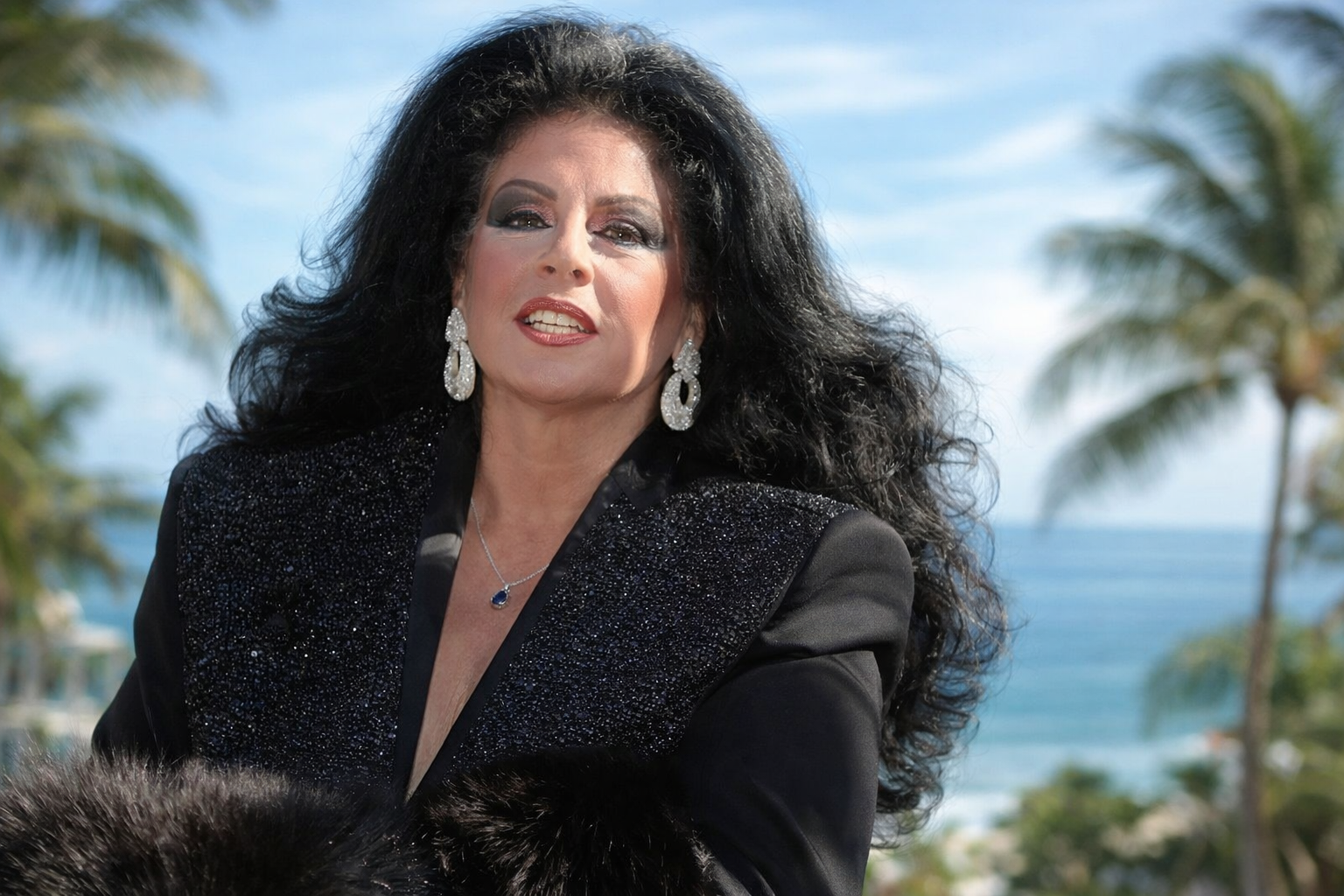
Adrienne Rodriguez Brown did not set out to become a public figure. Yet by the late 1980s, her name was appearing in police reports, courtrooms, and headlines tied to one of the most famous entertainers in American music history. For many readers today, she is remembered primarily as the third wife of James Brown, the legendary “Godfather of Soul.” But that label, while accurate, flattens a life that intersected with Hollywood work, personal ambition, and a turbulent marriage that unfolded in full public view.
Her story is not one of celebrity in the traditional sense. It is instead a portrait of someone who lived on the edge of fame, pulled into its orbit through marriage, and whose life—and death—still raise questions decades later. Adrienne Rodriguez’s biography remains partly obscured by conflicting reports, incomplete records, and a media environment that often preferred spectacle over clarity. What can be said with confidence is grounded in contemporaneous reporting and official records, and that version is more restrained, but also more honest.
Early Life and Background
Adrienne Lois Rodriguez is widely believed to have been born in the United States around 1950, though even this basic detail is not uniformly documented across sources. Some records and genealogy entries list March 9, 1950, as her birthdate, but contemporaneous reporting at the time of her death reflected uncertainty about her exact age. That inconsistency has followed her story ever since, with later profiles often presenting precise details that are difficult to verify.
What is clearer is that she grew up outside the spotlight. There is little reliable public documentation about her childhood, family structure, or education, which suggests she did not come from a well-known or publicly documented background. Unlike many celebrity spouses who were already part of the entertainment world, Rodriguez appears to have built her early career quietly, without media attention.
That relative anonymity makes her later visibility all the more striking. By the time her name began appearing in national headlines, it was not because of her upbringing or independent fame, but because of her relationship with one of the most recognizable figures in American music.
Early Career in Television
Before her marriage to James Brown, Adrienne Rodriguez worked as a hairstylist in the entertainment industry. This is one of the most consistently reported aspects of her professional life and is supported by contemporaneous news coverage. She was credited with working on television productions, including the long-running soap opera Days of Our Lives and the music and dance program Solid Gold.
That kind of work placed her inside the entertainment ecosystem without making her a public figure. Hairstylists in television operate behind the scenes, but their work is essential to production, especially in an era when visual presentation was tightly controlled. Rodriguez’s role suggests she was skilled enough to secure work on major productions, which in turn indicates a level of professional competence often overlooked in later retellings of her life.
There are scattered claims online that she had a career as a singer or songwriter, sometimes tied loosely to the name Adrienne Brown. But these claims are difficult to verify with strong primary sources. Music database entries exist, but they do not establish a widely recognized or documented career in the industry. The clearest and most reliable evidence points to her work in television hairstyling as her primary profession.
Marriage to James Brown
Adrienne Rodriguez married James Brown in 1984, becoming his third wife. At the time, Brown was already a towering figure in American music, known for his influence on funk, soul, and rhythm and blues. Their marriage placed Rodriguez directly into a world defined by fame, pressure, and constant public scrutiny.
From early on, the relationship was marked by instability. Reports from the late 1980s describe a volatile marriage that frequently drew the attention of law enforcement. By 1988, their relationship had become the subject of national headlines, with both parties involved in legal disputes and allegations of misconduct.
One of the most widely reported incidents occurred in April 1988, when James Brown was charged with aggravated assault and battery and assault with intent to kill after Rodriguez alleged that he had attacked her during a domestic dispute. According to reports at the time, she suffered visible injuries and required medical attention. Brown denied wrongdoing, and the case became part of a broader pattern in which allegations were made, charges were filed, and then legal proceedings shifted or collapsed when Rodriguez declined to testify.
That pattern complicates the public record. On one hand, there are multiple documented allegations of domestic violence across several years. On the other, the legal outcomes were often inconclusive, reflecting the challenges victims face in pursuing charges, especially when the accused is a powerful public figure.
A Marriage Under Public Scrutiny
The late 1980s and early 1990s saw repeated episodes that kept the couple in the news. Rodriguez filed for divorce at one point, citing years of cruel treatment, though the relationship did not end immediately. Reports from the time describe a cycle of separation and reconciliation that extended over several years.
There were also incidents involving allegations against Rodriguez herself. In 1988, she was charged with arson in connection with a fire at Brown’s property, though the details and outcome of that case remain less clearly documented in public records. These cross-accusations contributed to a narrative of mutual instability that media coverage often amplified.
What emerges from this period is not a simple story of victim and perpetrator, but a deeply troubled relationship shaped by power imbalance, personal conflict, and public exposure. That complexity is often lost in simplified retellings, but it is central to understanding why Adrienne Rodriguez’s life continues to attract attention.
Later Years of the Marriage
The instability did not end as the 1990s began. In October 1995, James Brown was arrested again on a domestic violence charge at their home in South Carolina. Reports indicated that Rodriguez had suffered another beating and sought medical treatment. As in earlier cases, the legal process did not lead to a definitive resolution, but the incident reinforced the long-standing pattern of alleged abuse.
Counselors and advocates who later spoke publicly described seeing Rodriguez in distress during this period. Their accounts add weight to the broader narrative, even as they highlight the difficulty of documenting private violence in a way that satisfies legal standards. For readers today, these accounts provide context, but they must be understood alongside the limitations of the available evidence.
By the end of 1995, the marriage had endured years of conflict, legal trouble, and public scrutiny. It was within this context that Adrienne Rodriguez’s life came to an abrupt and unexpected end.
Her Death in 1996
Adrienne Rodriguez died on January 6, 1996, at a Beverly Hills hospital after collapsing at a recovery clinic. She had undergone elective cosmetic surgery two days earlier and was staying at an after-care facility when she became unresponsive. Paramedics transported her to the hospital, where she was pronounced dead.
Initial reports did not identify a clear cause of death. Officials stated that the surgery itself did not appear to be directly responsible, and there was no immediate indication of foul play. However, they also noted that further testing would be required to determine the exact cause.
The Los Angeles County coroner later ruled her death accidental. The official finding cited a combination of heart disease and the presence of PCP in her system, with the physical stress of surgery contributing to her weakened condition. Additional substances, including prescription medications, were also reported to have been present.
This ruling remains the official explanation. It is supported by the coroner’s findings and has not been overturned. Yet it did not end public speculation, which has persisted for decades.
Lingering Questions and Later Investigations
The circumstances surrounding Adrienne Rodriguez’s death have continued to attract attention, particularly in the years following James Brown’s own death in 2006. Renewed scrutiny of Brown’s life brought renewed interest in the people around him, including his former wife.
In 2019, a CNN investigative series revisited both Brown’s death and aspects of his personal life, including Adrienne Rodriguez’s case. The reporting highlighted an allegation from a former police informant who claimed that a doctor had intentionally caused her death through a drug overdose. This claim was not supported by conclusive evidence, and authorities in 1996 had found no indication of homicide.
The key distinction is that these later claims reopened questions but did not establish new facts. The official ruling of accidental death remains in place, and no legal authority has reclassified the case. For readers, this creates a situation where uncertainty persists, but the evidence does not support definitive alternative conclusions.
Public Image and Media Portrayal
Adrienne Rodriguez’s public image has been shaped largely by her marriage and its fallout. Media coverage during her lifetime often framed her in relation to James Brown, emphasizing conflict and controversy rather than her individual identity. This pattern continued after her death, with many accounts focusing on the mystery surrounding her final days.
What’s surprising is how little attention has been given to her life outside that context. Her professional work, personal ambitions, and day-to-day experiences are rarely explored in depth. Instead, she is often reduced to a supporting character in someone else’s story.
That framing reflects broader patterns in celebrity culture, where the lives of spouses—especially women—are often filtered through the lens of their more famous partners. In Rodriguez’s case, it has contributed to a legacy that is both widely known and poorly understood.
Financial Life and Net Worth
There is no widely accepted or well-documented estimate of Adrienne Rodriguez’s personal net worth. Unlike many public figures, she did not have a career that generated publicly reported earnings on a large scale. Her work as a hairstylist would have provided income, but not at a level typically tracked in financial reporting.
Her financial situation during her marriage to James Brown is also difficult to reconstruct. Brown himself was known to have significant wealth at various points in his career, but his finances were complex and sometimes unstable. Public records do not provide a clear picture of Rodriguez’s independent financial standing or any settlements related to their marriage.
For readers searching for a net worth figure, the honest answer is that no reliable, verifiable estimate exists. Any figures circulating online should be treated with skepticism unless supported by credible documentation.
Where Adrienne Rodriguez Fits in Cultural Memory
Adrienne Rodriguez occupies an unusual place in public memory. She is neither a major celebrity nor an entirely private individual. Her life intersects with one of the most influential figures in American music, yet her own story remains partially obscured.
Her significance lies less in personal fame and more in what her life reveals about the intersection of celebrity, power, and personal relationships. The allegations of domestic violence that surrounded her marriage have become part of the broader reassessment of James Brown’s legacy. In that sense, her story contributes to a larger cultural conversation about how we understand and evaluate public figures.
At the same time, her death continues to draw attention because it resists easy explanation. Even with an official ruling in place, the combination of circumstances has kept the case in public discussion, especially among those interested in unresolved or controversial deaths.
Frequently Asked Questions
Who was Adrienne Rodriguez?
Adrienne Rodriguez, also known as Adrienne Brown after her marriage, was the third wife of musician James Brown. She worked as a television hairstylist and became widely known through her turbulent marriage, which brought her into the public eye during the 1980s and 1990s.
What did Adrienne Rodriguez do for a living?
She worked primarily as a hairstylist in the television industry. Reports from the time of her death confirm that she worked on productions such as Days of Our Lives and Solid Gold. Claims about a separate music career are not strongly supported by reliable sources.
How did Adrienne Rodriguez die?
She died on January 6, 1996, after collapsing at a recovery clinic following cosmetic surgery. The official cause of death was ruled accidental, involving heart disease and drug-related factors, with surgery contributing to her condition.
Was her death ever ruled suspicious or a homicide?
No. Authorities at the time found no evidence of foul play, and the coroner ruled the death accidental. Later investigations raised questions but did not change the official conclusion.
Did Adrienne Rodriguez have children with James Brown?
There is no clear, widely documented evidence that the couple had children together. Some sources suggest they did not, but this has not been consistently detailed in primary records.
Why is Adrienne Rodriguez still talked about today?
Her name remains relevant because of ongoing interest in James Brown’s life and legacy, especially in light of documentaries and investigations that revisit his personal relationships. Her death also continues to draw attention due to lingering questions and public curiosity.
Conclusion
Adrienne Rodriguez’s life does not fit neatly into the categories that usually define public figures. She was not a household name in her own right, yet her connection to one of the most famous musicians of the 20th century ensured that her story would not fade entirely. The details that remain are uneven, shaped by media coverage that focused more on conflict than context.
What stays with you is not a single defining moment, but a series of fragments: a professional working behind the scenes in television, a marriage marked by repeated allegations of violence, and a death that was officially explained but never fully settled in the public mind. These fragments resist easy interpretation, which is why her story continues to draw attention.
There is a tendency to look for closure in biographies like this, to find a clear answer that resolves the uncertainty. But Adrienne Rodriguez’s life suggests something different. It shows how public narratives can obscure as much as they reveal, and how the people closest to fame are often the least fully understood.
Her story remains, not because every question has been answered, but because enough of it still feels unresolved to matter.
