

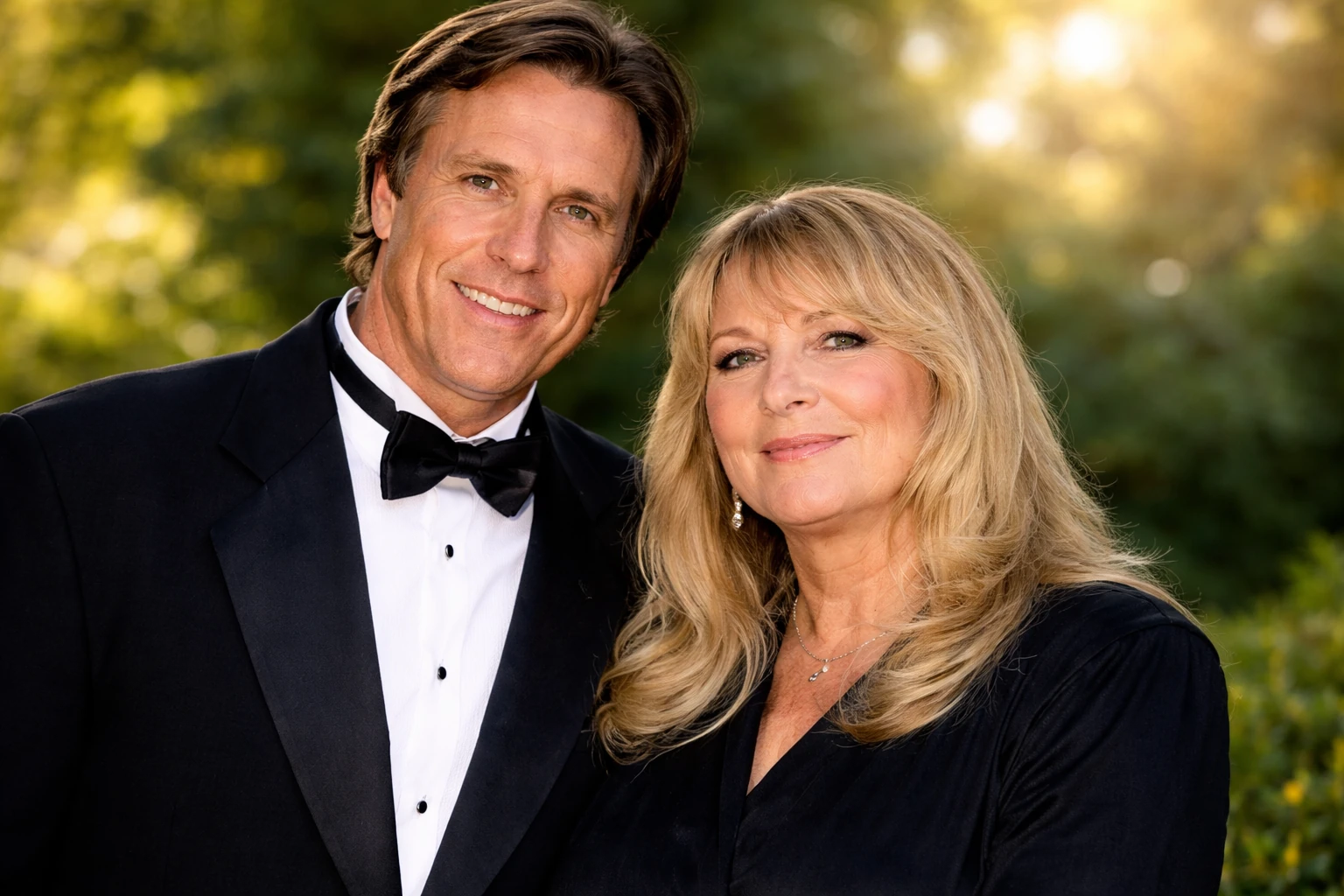
Mary Carey Van Dyke has spent decades close to one of television’s most recognizable families without ever becoming a conventional public figure herself. Her name surfaces in interviews, family retrospectives, and entertainment databases, usually in relation to her husband, actor Barry Van Dyke, and his father, Dick Van Dyke. Yet beyond those references, the record thins out quickly. That contrast—proximity to fame paired with a largely private life—is what makes her both intriguing and difficult to profile with precision.
For readers who come looking for a full celebrity biography, the reality can feel unexpectedly quiet. Mary Carey Van Dyke is not known for a public acting career, a string of media appearances, or an independent celebrity brand. Instead, she is best understood as a central figure within the Van Dyke family itself: a longtime partner, a mother of four, and part of a household that bridged generations of television history. Her story is less about personal publicity and more about continuity, stability, and the kind of influence that rarely appears on a résumé.
Early Life and Background
One of the defining challenges in writing about Mary Carey Van Dyke is the limited public documentation of her early years. Unlike her husband and children, whose work in film and television has generated verifiable records, Mary’s upbringing has not been widely covered in mainstream publications. There are no confirmed details about her exact birth date, birthplace, or formal education in widely cited sources.
What can be stated with confidence is that she met Barry Van Dyke as a teenager. According to interviews and family profiles, the two crossed paths when they were both 16 years old, during Barry’s early working years as a movie theater employee. That detail, repeated in reliable profiles of Barry’s life, provides one of the earliest fixed points in Mary’s timeline.
The absence of detailed early-life information is not unusual for someone who did not pursue a public career. In many cases, individuals connected to prominent families only enter the public record when their relationships become relevant to someone else’s story. For Mary, that moment came through her relationship with Barry Van Dyke, rather than through a separate professional identity.
Meeting Barry Van Dyke and Building a Life Together
The story of Mary Carey Van Dyke’s adult life begins, in many ways, with Barry Van Dyke. Their relationship is often described as a long-standing partnership that started in adolescence and matured into a lifelong marriage. The fact that they met as teenagers and remained together into adulthood stands out in an industry known for short-lived relationships.
Sources generally agree that the couple married in the mid-1970s, though the exact year is not perfectly consistent across all records. Some profiles place the marriage in 1974, while others suggest 1975. Rather than treating that discrepancy as a flaw, it reflects the reality of piecing together a life that was never heavily documented in the press at the time.
What is clear is the longevity of the marriage. Mary and Barry Van Dyke have been together for more than five decades, a rare milestone in Hollywood-adjacent circles. Their relationship has endured through Barry’s acting career, the rise of their children’s careers, and the continued public attention on the Van Dyke name.
Marriage into the Van Dyke Family
Mary’s marriage brought her into one of television’s most respected families. Barry Van Dyke is the son of Dick Van Dyke, whose career spans classics such as The Dick Van Dyke Show, Mary Poppins, and Chitty Chitty Bang Bang. That lineage placed Mary within a family that was already deeply embedded in American entertainment culture.
Despite that connection, Mary did not step into the spotlight in the way some spouses of celebrities do. She appeared occasionally at public events alongside Barry, including industry award ceremonies, but she did not cultivate a public persona tied to the family’s fame. Instead, her presence remained largely within the private sphere of family life.
This dynamic shaped how she is remembered and discussed. In media coverage, Mary is rarely the subject of a standalone feature. Instead, she is referenced as part of the broader Van Dyke narrative, often in the context of Barry’s career or the achievements of their children. That framing can obscure her individual identity, but it also reflects the role she appears to have chosen.
Raising a Second Generation
Mary Carey Van Dyke’s most visible contribution to the public record comes through her children. She and Barry have four children together: Carey, Shane, Wes, and Taryn Van Dyke. All four have, to varying degrees, worked in the entertainment industry, continuing the family’s connection to film and television.
Carey Van Dyke, born in 1976, pursued acting and writing, appearing in projects connected to the family’s work. Shane Van Dyke, born in 1979, also built a career as an actor, director, and writer, with credits that extend beyond family productions. Their collaborative work has included screenwriting, and reports have linked them to projects that later gained wider attention in Hollywood.
Wes Van Dyke, born in 1984, and Taryn Van Dyke, born in 1986, have smaller but documented acting credits. Both appeared in television projects such as Diagnosis: Murder, a series that became a central part of the Van Dyke family’s shared professional life. While their careers have been less prominent than those of their father and grandfather, they still form part of the family’s multi-generational presence in entertainment.
For Mary, this second generation represents more than a list of credits. It reflects the environment in which her children were raised—one where acting, writing, and production were part of daily life. While she did not publicly claim a creative role in those projects, her position within the family suggests she was closely connected to that world behind the scenes.
The Diagnosis: Murder Years
To understand Mary Carey Van Dyke’s place in the public imagination, it helps to look at the period when the Van Dyke family was most visible together. Diagnosis: Murder, which aired from 1993 to 2001, starred Dick Van Dyke and Barry Van Dyke as father and son. The show became a defining project for both actors and a focal point for the family’s on-screen collaborations.
During that time, several members of the extended family appeared in episodes, reinforcing the sense of a real-life family working together. This included Barry and Mary’s children, who took on guest roles or recurring appearances. The show became, in some ways, a family enterprise.
Mary herself was not credited as an actor in the series, but her presence during those years was still part of the broader family story. She was connected to a household where work and family life overlapped in visible ways. That proximity has led some to assume a more direct involvement than the public record supports, but the available evidence suggests her role remained outside the camera’s frame.
A Life Largely Outside the Spotlight
One of the most striking aspects of Mary Carey Van Dyke’s biography is how consistently she has stayed out of the spotlight. In an era when even secondary figures in celebrity families often maintain public profiles, she has remained largely absent from interviews, social media, and entertainment coverage.
This absence is not accidental. It reflects a broader pattern of privacy that has defined her public image. While Barry Van Dyke’s career required a degree of visibility, Mary appears to have chosen a different path, focusing on family life rather than public exposure.
That choice shapes how she is perceived. Instead of being defined by roles, awards, or public statements, she is known through relationships and context. For some readers, that can feel like a lack of information. For others, it offers a glimpse into a different way of living within a celebrity-adjacent world.
Public Image and Media Portrayal
Because Mary Carey Van Dyke has not cultivated a public persona, the media portrayal of her is relatively neutral. She is typically described in straightforward terms: Barry Van Dyke’s wife, a mother of four, and a member of the Van Dyke family. There are no widely reported controversies, public disputes, or headline-making events tied to her name.
That absence of drama is unusual in celebrity coverage, where even minor details can become amplified. In Mary’s case, the lack of sensational material has contributed to a quieter, more stable public image. She is not the subject of tabloid speculation or recurring news cycles.
At the same time, this limited portrayal can lead to oversimplification. Some online profiles attempt to fill in gaps with unverified details, presenting speculative information as fact. Readers who want an accurate picture need to rely on the more restrained, evidence-based accounts that avoid those additions.
Financial Standing and Net Worth
There is no publicly verified net worth figure specifically for Mary Carey Van Dyke. Like many private individuals connected to public figures, her financial standing is typically considered in relation to her husband’s career. Barry Van Dyke, through decades of acting work, has accumulated a level of financial stability that supports the family.
Estimates of Barry Van Dyke’s net worth vary across sources, and those figures should be treated as approximations rather than confirmed data. What can be said with confidence is that his long-running television career, including Diagnosis: Murder and other projects, provided a steady income over many years.
Mary’s role in that financial picture is not publicly detailed. There are no widely confirmed records of independent business ventures or entertainment earnings tied to her name. This reinforces the broader theme of her biography: a life that intersects with public success without being defined by it.
Later Years and Current Status
As of recent years, Mary Carey Van Dyke remains largely out of public view. Barry Van Dyke has made fewer screen appearances compared to the peak of his career, and the family’s public visibility now often centers on Dick Van Dyke’s legacy and milestone celebrations.
Mary continues to be referenced in family-focused articles and retrospectives, particularly those that highlight the longevity of her marriage to Barry. That relationship, now spanning more than half a century, stands as one of the most enduring aspects of her public identity.
There is no widely reported information about her current daily activities, residence, or personal pursuits. This lack of detail is consistent with the way her life has been documented over the years. She remains present in the background of the Van Dyke story, rather than at its center.
Frequently Asked Questions
Who is Mary Carey Van Dyke?
Mary Carey Van Dyke is best known as the wife of actor Barry Van Dyke and a member of the extended Van Dyke family. She has not built a public career in entertainment, which is why information about her life is limited compared to other family members.
When did Mary Carey Van Dyke get married?
She married Barry Van Dyke in the mid-1970s. Sources differ on the exact year, with some citing 1974 and others 1975, but all agree that the couple has been married for more than five decades.
Does Mary Carey Van Dyke have children?
Yes, she and Barry Van Dyke have four children: Carey, Shane, Wes, and Taryn. All four have appeared in film or television projects, continuing the family’s connection to the entertainment industry.
Is Mary Carey Van Dyke an actress?
There is no strong public record confirming a professional acting career for Mary Carey Van Dyke. While her husband and children have documented credits, she is primarily known for her role within the family rather than for on-screen work.
What is Mary Carey Van Dyke’s net worth?
There is no confirmed net worth figure for Mary Carey Van Dyke. Any financial estimates are typically tied to her husband’s career and should be treated as approximations rather than verified numbers.
Why is there so little information about her?
Mary Carey Van Dyke has lived largely outside the public spotlight. Because she did not pursue a high-profile career or media presence, fewer details about her life have been documented in widely cited sources.
Conclusion
Mary Carey Van Dyke’s story does not follow the usual arc of a celebrity biography. There are no dramatic career shifts, headline-making controversies, or carefully curated public appearances. Instead, her life is defined by steadiness, long-term relationships, and a consistent distance from the spotlight.
That distance is part of what makes her interesting. In a culture that often rewards visibility, Mary’s relative privacy stands out. She has remained closely connected to a family that shaped American television while maintaining a life that is largely her own.
Her biography, as a result, is not a story of fame in the traditional sense. It is a story about proximity to it, and about the quieter roles that support and sustain public success. For readers willing to look beyond the usual markers of celebrity, that story has its own kind of weight.
In the end, Mary Carey Van Dyke matters not because of what is widely known about her, but because of how she fits into a larger narrative. She is part of a family legacy that continues to resonate, even as she herself remains just outside its brightest light.
