

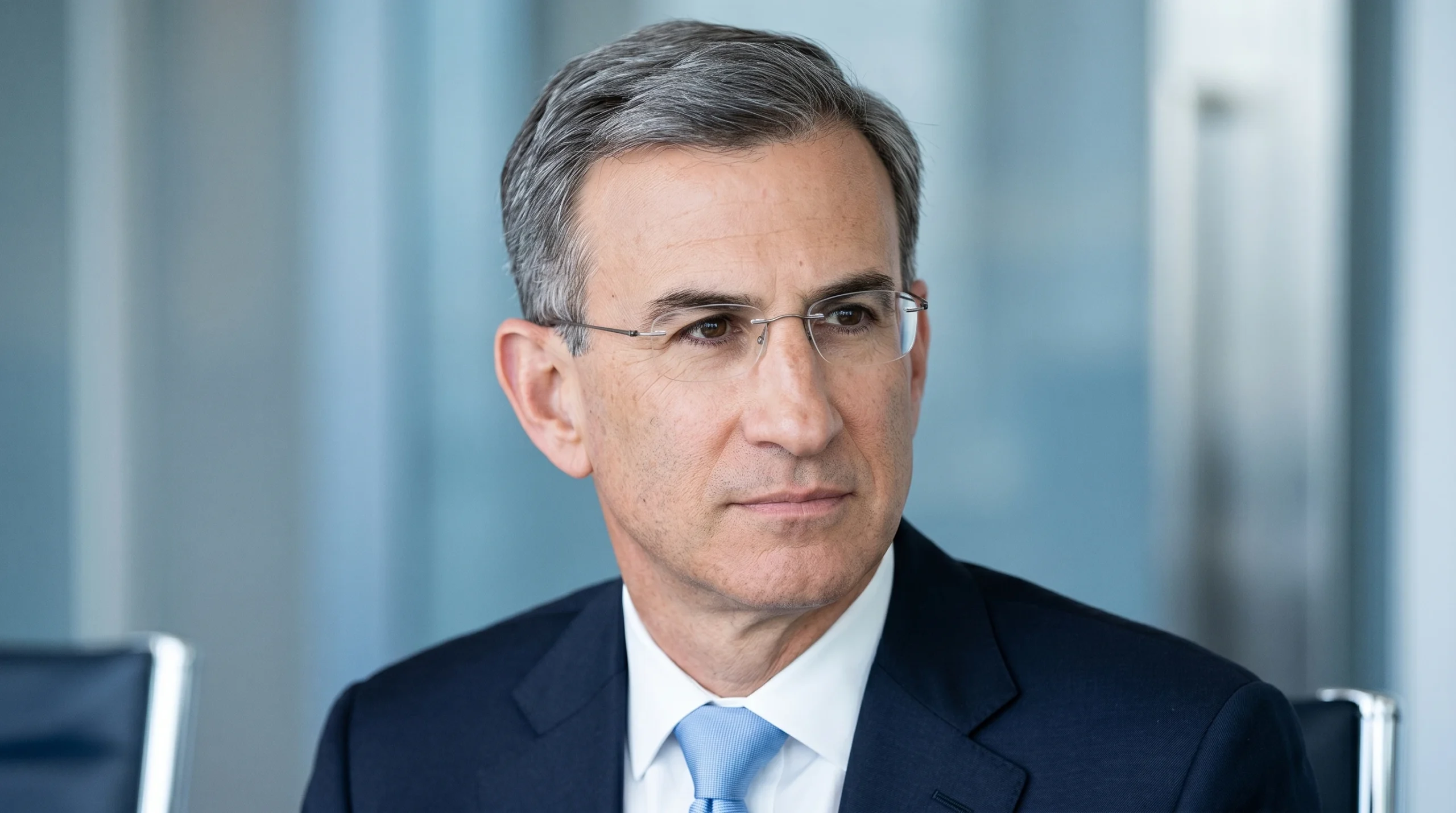
Peter Orszag has spent much of his adult life in rooms where numbers become policy, policy becomes power, and power eventually meets the market. He is an economist by training, a former senior official in Washington, and the chairman and chief executive of Lazard, one of Wall Street’s best-known advisory firms. Yet one of the plainest search phrases attached to his name is not about budgets, banking, health care, or global finance. It is “peter orszag bald,” a query that says as much about internet curiosity as it does about the man himself.
The straightforward answer is that Orszag does not appear to be fully bald in public images. He appears to have a receding hairline and thinning gray hair, which is common for men in their 50s. There is no reliable public evidence that he has worn a wig, had a hair transplant, or spoken publicly about hair loss. The more useful story is the biography behind the search: how a data-minded son of academia became a leading policy figure, crossed into finance, and remained visible enough for even his appearance to become a small online subject.
Early Life and Family Background
Peter Richard Orszag was born on December 16, 1968, in Massachusetts, into a family where education and intellectual work were part of daily life. His father, Steven Orszag, was a respected mathematician known for his work in applied mathematics, fluid dynamics, and numerical analysis. His mother, Reba Karp, also came from an academic and scholarly background. That family setting helps explain why Orszag’s public identity has always leaned toward analysis rather than performance.
He grew up around the culture of universities, where argument, evidence, and precision mattered. That kind of childhood can shape a person quietly, especially when the family model prizes careful reasoning over easy certainty. Orszag’s later career would follow that pattern: he became the sort of public figure who spoke through charts, projections, cost estimates, and policy memos. Even when he entered more visible roles, he never became a conventional political celebrity.
His brother, Jonathan Orszag, also built a career in economics and consulting, which suggests a household where public policy and quantitative work were not abstract ideas. Peter Orszag’s own path would eventually take him far beyond the academy, but the foundation was there early. He developed the profile of someone comfortable moving between ideas and institutions. That ability would later become one of his defining professional traits.
Education and First Ambitions
Orszag attended Phillips Exeter Academy, one of the country’s most selective preparatory schools, before going on to Princeton University. At Princeton, he studied economics and graduated summa cum laude in 1991. He then became a Marshall Scholar, earning graduate degrees at the London School of Economics. His academic record placed him among a generation of policy economists who moved easily between universities, government, and high-level advisory work.
His time at the London School of Economics sharpened a career built around public finance, labor markets, social policy, and macroeconomic questions. He earned both a master’s degree and a doctorate in economics there. That training mattered because Orszag entered public life not as a campaign operative or elected official, but as an expert. His authority came from an ability to explain how government choices affected budgets, households, companies, and long-term economic growth.
Early in his career, Orszag worked in the Clinton administration as a special assistant to the president for economic policy and as a senior economist at the Council of Economic Advisers. Those roles put him near the center of national policy before he was widely known to the public. He was not yet a household name, but he had entered the pipeline that shapes economic decision-making in Washington. His career was already showing its main pattern: technical expertise paired with access to decision-makers.
Building a Reputation in Policy
After his early government work, Orszag became a senior fellow at the Brookings Institution, one of Washington’s most influential policy research organizations. At Brookings, he focused on budget policy, retirement security, health care costs, and the long-term fiscal pressures facing the United States. These were not flashy topics, but they were central to the country’s future. Orszag became known among policy insiders as a disciplined analyst with a strong command of numbers.
His writing and research often centered on a question that would later dominate national politics: how could the United States manage rising health-care costs without damaging economic stability? That question connected federal spending, family budgets, business costs, and political trust. Orszag’s strength was his ability to make those connections without turning them into slogans. He treated fiscal policy as a practical problem, not merely an ideological contest.
That reputation helped lead to one of the most important appointments of his career. In January 2007, Orszag became director of the Congressional Budget Office, the nonpartisan agency that provides budget and economic analysis to Congress. The CBO director is not usually a mass-media figure, but the office can shape major policy debates. Under Orszag, the agency became especially visible during fights over health care, taxes, and the federal deficit.
The Congressional Budget Office Years
Orszag’s tenure at the Congressional Budget Office came at a tense time. The country was approaching the financial crisis, health-care costs were rising, and long-term federal spending projections were becoming harder to ignore. As CBO director, Orszag had to maintain the agency’s nonpartisan credibility while producing estimates that political actors often used as weapons. That role required technical skill, but it also required restraint.
He became known for emphasizing the fiscal threat posed by health-care spending. In his view, the long-term budget challenge was not simply that government spent too much in general. The deeper issue was that medical costs were rising faster than the economy could comfortably sustain. That framing influenced how policymakers discussed Medicare, Medicaid, insurance reform, and the broader health system.
The CBO job made Orszag a more recognizable figure in Washington. He testified before Congress, appeared in policy discussions, and became a trusted voice for reporters covering budget debates. He was not flashy, but he was clear. In a city often built around political theater, his appeal came from the sense that he preferred evidence to applause.
The Obama White House and National Visibility
In late 2008, President-elect Barack Obama chose Orszag to serve as director of the Office of Management and Budget. He took office in January 2009, at a moment of extraordinary economic strain. The financial crisis had damaged banks, household wealth, employment, and public confidence. The new administration faced pressure to stabilize the economy while also pursuing major policy goals.
As OMB director, Orszag helped shape federal budget planning during the early Obama years. The job placed him inside the White House at the intersection of economic recovery, health-care reform, stimulus spending, and deficit concerns. He was one of the administration’s leading voices on the idea that health-care reform and fiscal discipline were connected. That argument became central to the policy case for the Affordable Care Act.
His public profile grew during this period, partly because the Obama administration included several highly visible policy figures. Orszag appeared in briefings, interviews, and long-form policy discussions. He was often presented as a numbers man, someone who could translate large fiscal questions into plain explanations. That visibility also meant that his image became more familiar to the public, which is one reason later searches about his appearance exist at all.
Health-Care Reform and a Defining Policy Fight
The health-care reform debate was one of the defining chapters of Orszag’s government career. He argued that slowing the growth of health-care costs was essential for the federal budget and the wider economy. That view did not belong to him alone, but he became one of its most prominent messengers inside the administration. His role was to connect the technical budget case with the political urgency of reform.
The Affordable Care Act became law in March 2010, after a long and bruising national fight. Orszag’s work was part of the broader White House effort to defend the legislation as both a coverage expansion and a cost-control measure. Supporters saw that argument as essential, while critics questioned whether the promised savings would appear. The debate over health-care costs has continued for years, but Orszag’s place in that early fight remains part of his public record.
He left the Obama administration in July 2010. Departures from senior White House roles are common after intense stretches of service, and Orszag had served during one of the most demanding periods in recent economic history. By then, he was no longer just a policy specialist known to insiders. He had become a national figure associated with budgets, health care, and the economic architecture of the Obama presidency.
A Move Into Finance
After leaving government, Orszag moved into the private sector, first joining Citigroup. The move drew attention because former senior officials often face scrutiny when they enter finance, especially after working on economic policy during a financial crisis. Orszag’s defenders could point to his expertise in markets, regulation, health care, and public finance. Critics of Washington’s revolving door saw the move as part of a broader pattern in which public officials later profit from private-sector demand for their knowledge and networks.
At Citigroup, he worked in senior roles connected to strategy and investment banking. The transition made sense on one level because large financial institutions value people who understand government, regulation, and macroeconomic risk. But it also shifted how the public saw him. He was no longer only a budget expert; he was part of the world he had once helped regulate from inside government.
In 2016, Orszag joined Lazard, a firm with a long history in financial advisory and asset management. He rose through senior roles, including leadership positions in investment banking and financial advisory. His background in health care and public policy gave him a distinctive profile among bankers. He could speak to corporate boards not only about transactions, but also about regulation, demographics, public spending, and political risk.
Lazard and Leadership in Wall Street Advisory
Orszag became chief executive officer of Lazard on October 1, 2023, succeeding Kenneth Jacobs in that role. He later became chairman as well, giving him a dual leadership position at a firm known for advising companies, governments, and investors. Lazard is not a giant balance-sheet bank in the mold of JPMorgan Chase or Goldman Sachs. Its identity rests more heavily on advice, relationships, restructuring work, and senior judgment.
As CEO, Orszag inherited a firm facing a changed deal environment. Higher interest rates, geopolitical uncertainty, and shifts in corporate strategy affected mergers and acquisitions. Asset management also faced industry pressure from lower fees, passive investing, and changing client expectations. The task before him was not simply to preserve Lazard’s prestige, but to adapt the firm to a more competitive market.
His leadership style has often been described through the lens of data and systems thinking. That is consistent with his career, from economics to public budgeting to advisory work. He has shown interest in artificial intelligence and productivity, especially in how technology might reshape banking advice and internal research. But here’s the thing: Orszag’s strongest professional brand is still not tech enthusiasm. It is the ability to link broad economic forces to institutional decisions.
Marriage, Children, and Family Life
Peter Orszag is married to Bianna Golodryga, a journalist known for her work with CNN and earlier roles at major broadcast outlets. The couple married in 2010, the same year Orszag left the Obama administration. Their marriage attracted attention partly because both were public figures in elite Washington and media circles. Even so, they have generally kept much of their family life outside the spotlight.
Orszag has children, though responsible coverage should avoid overstating private family details beyond what has been publicly shared. He has been the subject of media coverage about past relationships and family matters, but those episodes should not define a biography that spans economics, government, and finance. Public figures have private lives, and not every personal detail carries equal public value. The most relevant point is that Orszag’s family life exists alongside an unusually demanding career.
Golodryga’s own career has kept the family connected to media as well as policy and finance. That has made Orszag more recognizable to some readers who may know him through television, interviews, or public events rather than through budget debates. Their marriage is part of his public profile, but it is not the core explanation for his influence. His career stands on its own record.
Peter Orszag’s Public Image and the Bald Search
The search phrase “peter orszag bald” reflects a common internet habit: reducing a public person to a visible trait. In Orszag’s case, the question likely comes from comparing older photographs from his government years with more recent appearances as a finance executive. In earlier images, he appeared with darker and fuller hair. In later public appearances, his hair looks grayer and thinner, with a more receded hairline.
That change is not unusual for a man born in 1968. By the mid-50s, many men have some degree of hair thinning or recession. Orszag does not appear fully bald in public images, and there is no sound basis for claims about wigs or hair procedures. The honest answer is less dramatic than the search phrase: he appears to have age-related thinning hair.
Appearance searches can be harmless, but they can also distort how readers approach a serious public figure. Orszag’s hair has no bearing on his economic judgment, his tenure at CBO, his work in the Obama White House, or his leadership at Lazard. Still, answering the query directly is useful because it cuts off baseless speculation. A clear description is better than rumor dressed up as certainty.
Money, Income Sources, and Net Worth
Peter Orszag’s income sources have changed as his career moved from public service to finance. Government salaries for senior officials are public and far lower than compensation at major financial firms. His later roles at Citigroup and Lazard would have placed him in a different earnings category. As CEO and chairman of Lazard, his compensation is tied to executive pay structures that can include salary, bonuses, stock awards, and other incentives.
Public estimates of Orszag’s net worth vary and should be treated carefully. Celebrity-style net worth sites often publish figures without showing reliable sourcing, and those numbers can be wrong by wide margins. A more responsible approach is to say that Orszag is likely wealthy by ordinary standards because of his senior finance roles, but precise personal wealth is not fully knowable from public information alone. Without verified financial filings that capture all assets and liabilities, any exact number should be labeled as an estimate.
His financial standing also reflects the broader arc of his career. He spent years in public service and policy research before entering high-paying private-sector roles. That path is common among senior economic officials who later become advisers, executives, board members, or investors. It can raise fair questions about influence and access, but it also reflects the market value placed on deep knowledge of policy and economic risk.
Controversies and Criticism
Orszag has not been a scandal-driven public figure, but his career has drawn criticism in areas where policy and finance overlap. The move from senior government service to Wall Street invited familiar concerns about the revolving door. Critics argue that the path from public office to private finance can blur lines between public duty and private opportunity. Supporters counter that expertise in government and markets can be valuable outside public office and does not automatically imply wrongdoing.
His policy views have also been debated, especially around health-care cost control and fiscal policy. Some liberals have viewed deficit-focused arguments with suspicion, worrying that they can become a case for cutting social programs. Some conservatives have rejected Democratic health-care reform arguments and questioned the long-term savings promised by the Affordable Care Act. Orszag has often occupied the technocratic center of those arguments, which can attract criticism from multiple sides.
What makes him interesting is that he has rarely seemed driven by ideological theater. His public posture has usually been analytical, sometimes so analytical that critics might find it bloodless. That style can be a strength in budget policy, where emotional arguments often outrun arithmetic. It can also make a public figure seem distant to readers who want a more personal sense of motivation.
What Peter Orszag Is Doing Now
Peter Orszag is now best understood as a finance executive with deep policy roots. At Lazard, he leads a firm that advises on mergers, restructurings, capital strategy, sovereign matters, and asset management. His job requires attention to global markets, corporate decision-making, political risk, and client trust. It is a long way from testifying before Congress, but the skill set overlaps more than it might first appear.
He remains part of a small circle of figures who can speak credibly to both Washington and Wall Street. That matters because companies and governments increasingly face problems that do not stay in one lane. A merger can run into antitrust scrutiny, a supply-chain decision can become a geopolitical issue, and a health-care deal can turn on regulation as much as valuation. Orszag’s background gives him a language for those crossings.
His current public image is quieter than during the Obama years, but in some ways his influence is broader. He is no longer the official presenting budget priorities from inside government. He is the executive advising institutions that make billion-dollar decisions. That makes him less visible to the average voter, but still important in the circles where policy, capital, and strategy meet.
Lesser-Known Details That Shape the Profile
One lesser-known part of Orszag’s profile is how consistent his core interests have been. Even as his titles changed, he stayed close to questions about health care, demography, fiscal pressure, and institutional decision-making. Those subjects may sound dry, but they shape the real conditions of public life. They affect what governments can afford, what companies choose to build, and what households pay.
Another revealing detail is the academic depth in his family background. His father’s work in mathematics was not just a credential; it reflected a serious culture of problem-solving. Peter Orszag did not become a mathematician in the same field, but he carried a related habit into economics and policy. He tends to approach public questions as systems with costs, incentives, and constraints.
His career also shows how modern elite influence often works. It does not always come through elected office or celebrity fame. It can come through advisory roles, research institutions, budget agencies, banks, and boardrooms. Orszag’s biography is a case study in that quieter form of power.
Frequently Asked Questions
Is Peter Orszag bald?
Peter Orszag does not appear to be fully bald based on public images. He appears to have thinning gray hair and a receding hairline, which is common for men in their 50s. The search phrase “peter orszag bald” likely comes from comparisons between older photos and more recent appearances.
There is no reliable public evidence that he has discussed hair loss in detail. There is also no credible basis for claims that he wears a wig or has had a hair procedure. The most accurate description is that his hair has thinned with age.
Who is Peter Orszag?
Peter Orszag is an American economist, former government official, and finance executive. He served as director of the Congressional Budget Office and later as director of the Office of Management and Budget under President Barack Obama. He is now chairman and chief executive officer of Lazard.
His career has moved across research, public policy, banking, and corporate advisory work. He is especially associated with federal budget policy, health-care economics, and financial strategy. That range is what makes him a lasting figure in both Washington and Wall Street circles.
How old is Peter Orszag?
Peter Orszag was born on December 16, 1968. That makes him a member of the generation of economists who came of age professionally during the Clinton years and later took senior roles during the financial crisis era. His age also explains why recent images show the ordinary visual changes that come with time.
Age matters in his biography because his career has unfolded across several major economic periods. He worked in public policy before the 2008 crisis, served in the Obama administration during its aftermath, and later moved into finance during a period of rapid market and technological change. Few public economists have had such a varied front-row seat.
Who is Peter Orszag married to?
Peter Orszag is married to journalist Bianna Golodryga. She is known for her work in television news, including roles connected to CNN and other major media organizations. Their marriage has drawn public interest because both have been visible in national media and policy circles.
They have generally kept much of their family life private. That is a reasonable boundary, even for people with public careers. The public facts about their marriage belong in a biography, but they do not need to become gossip.
What is Peter Orszag’s net worth?
There is no single confirmed public figure for Peter Orszag’s net worth. Online estimates should be treated with caution because many net worth sites do not show reliable methods or verified asset information. What can be said is that his senior roles in finance, especially at Lazard, likely place him among high-earning executives.
His income sources have included public-sector salary, think-tank and academic-related work, banking roles, advisory positions, and executive compensation. Without full verified disclosure of assets, debts, stock holdings, and private investments, any exact number would be speculative. A careful profile should avoid pretending otherwise.
Why is Peter Orszag famous?
Peter Orszag is famous in policy and finance circles because of his work on budgets, health-care economics, and financial advisory leadership. His time as CBO director and Obama’s OMB director made him a key figure in national economic debates. His later move to Lazard placed him in a major Wall Street leadership role.
He is not famous in the entertainment sense. His public importance comes from influence rather than mass celebrity. That is why his biography is best understood through institutions, decisions, and ideas rather than personality alone.
Conclusion
Peter Orszag’s life is a story about expertise moving through power. He began in an academic family, trained as an economist, entered government, helped shape budget and health-care debates, and later became a senior figure in finance. His path shows how much influence can belong to people who rarely campaign, perform, or seek ordinary fame.
The “peter orszag bald” search is a small, human entry point into that larger story. Yes, his appearance has changed over time, and yes, his hair appears thinner than it once did. But the honest answer is simple and limited: he does not appear fully bald, and there is no verified public story beyond ordinary age-related change.
What remains more important is the record. Orszag has been present at major turns in American economic life, from the fiscal debates before the financial crisis to the Obama health-care fight to the current pressures facing global advisory firms. His career is not easy to reduce to a slogan, which may be why the internet sometimes grabs onto something easier.
A fair biography should leave readers with the full picture: a serious economist, a powerful executive, a husband and father with a private family life, and a public figure whose influence has often been quieter than his titles suggest. The hair question can be answered in a sentence. The career takes longer, and it is the career that explains why people are still searching his name.
