

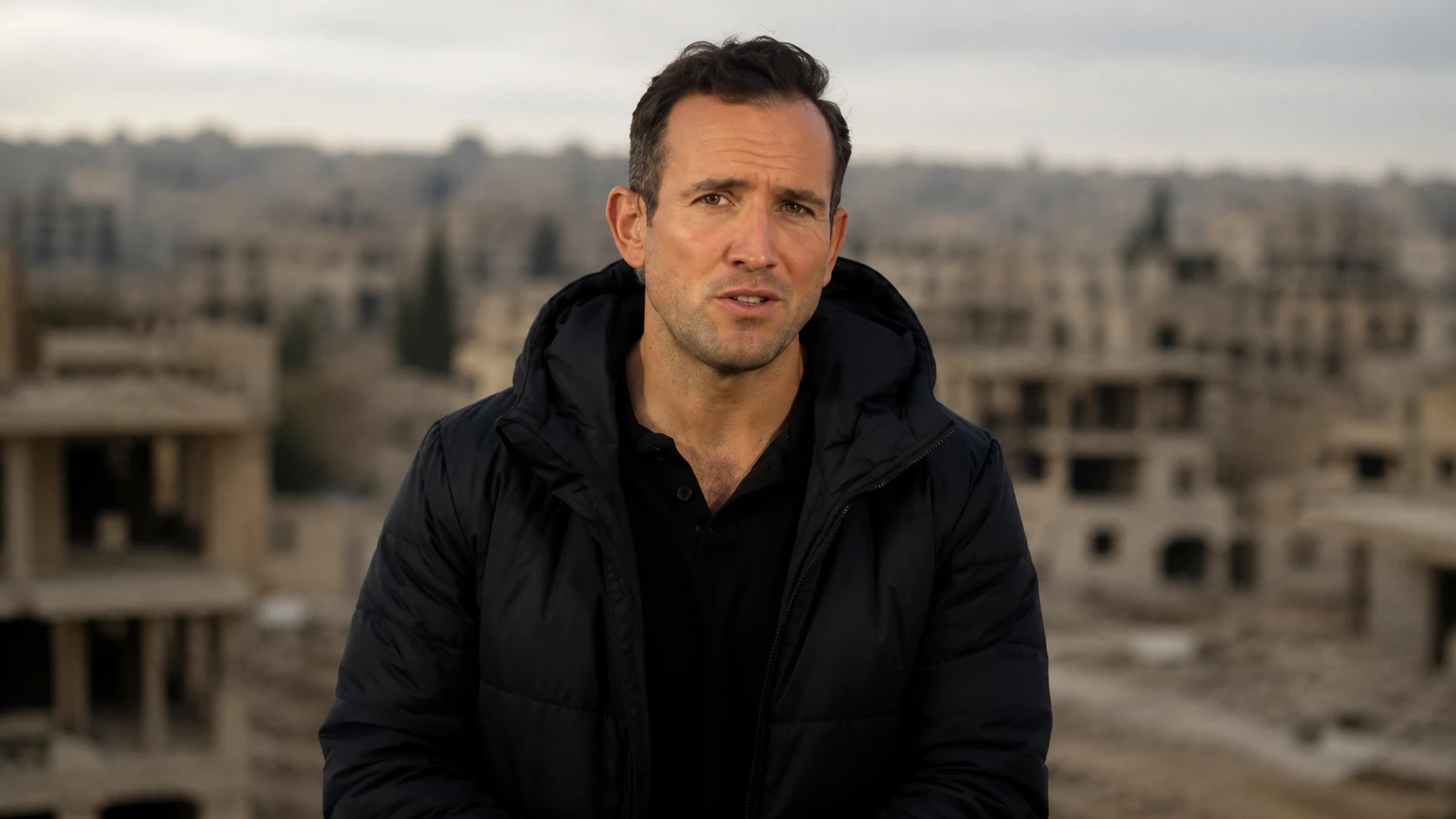
Hugo Bachega became familiar to many viewers in one of the most frightening ways a foreign correspondent can. During a live BBC report from Kyiv in October 2022, as Russian missiles struck the Ukrainian capital, he paused, looked toward the sound of explosions, and moved out of shot to take cover. The moment lasted only seconds, but it captured the reality of his work: reporting from places where history is not safely behind glass, but unfolding nearby, loud enough to interrupt the broadcast.
For audiences who follow the BBC’s international coverage, Bachega is known as a correspondent with a calm delivery and a serious beat. His reporting has taken him through Ukraine, Lebanon, and the wider Middle East, where war, diplomacy, civilian loss, and political power often collide. He is not a celebrity journalist in the usual sense, and he has not built his public image around personal revelations. His name matters because it appears beside some of the defining international stories of recent years.
Who Is Hugo Bachega?
Hugo Bachega is a Brazilian-born journalist and BBC correspondent best known for his international reporting from conflict and crisis zones. Public profiles have described him as a BBC Middle East correspondent, and his recent work has been closely associated with Lebanon, Israel, Gaza-related regional tensions, Hezbollah, and the war in Ukraine. Before becoming a recognizable BBC face, he began his career in Brazil, where he worked with Reuters in São Paulo.
His career has followed the path of a reporter trained in fast-moving news and later trusted with major foreign assignments. He has worked from several important news centers, including Cairo, London, Washington DC, Kyiv, and Beirut. Those postings show the range of his reporting life, from political power in the United States to war and diplomacy in Europe and the Middle East. They also explain why search interest in him often rises during major breaking-news periods.
Bachega’s public identity is built around work rather than private exposure. Reliable information is available about his career, nationality background, and reporting assignments, but much less is confirmed about his family life, age, spouse, salary, or net worth. That absence should not be treated as a puzzle to fill with guesses. For a working foreign correspondent, privacy is not unusual, and in dangerous beats it can be sensible.
Early Life and Brazilian Background
The most established public fact about Hugo Bachega’s origins is that he is Brazilian-born. Brazil is not just a biographical detail in his case; it helps explain the international texture of his career. He came into English-language global journalism from outside the traditional British media pipeline, which makes his route to the BBC more distinctive. Viewers who hear his accent and search his name are often trying to understand that background.
Public sources do not provide a detailed childhood biography. His exact date of birth, hometown, parents, siblings, schools, and early family life are not widely confirmed in reliable open records. That means any article that claims certainty about those details should be read carefully. What can be said with confidence is that his professional path began in Brazil before moving into wider international reporting.
That Brazilian starting point matters because São Paulo is one of the largest and most competitive media cities in the world. It is a place where politics, business, inequality, culture, and public crisis often meet in the same news cycle. A journalist beginning there would quickly learn how to report under pressure and how to write with discipline. Those habits are visible in Bachega’s later work, especially in his careful handling of conflict claims and official statements.
Education and Early Ambitions
Bachega has not made a long public story out of his education, and there is no widely verified record that confirms a full list of universities, degrees, or early academic milestones. Some profile notes have indicated that he spent time in the Middle East as a student, which helps explain his later connection to the region. Still, the precise timeline and institution details should not be stated as fact unless confirmed by him or by a high-trust biography. The responsible approach is to acknowledge what is known and avoid turning partial information into a complete backstory.
What his career does show is a strong early interest in international affairs. A reporter does not usually move from Brazil to Cairo, London, Washington, Kyiv, and Beirut without a deep commitment to global news. Bachega’s later assignments suggest that he developed the skills needed for cross-border reporting: speed, language sensitivity, political awareness, and the ability to explain unfamiliar events to a broad audience. Those qualities are often formed before a journalist becomes widely known.
His first ambitions likely centered on reporting rather than presentation. That distinction matters because Bachega’s public style does not resemble a broadcaster chasing attention. He works more like a correspondent shaped by wires, field reporting, and newsroom discipline. His rise appears to have come through reliability on difficult stories rather than through personality branding.
First Steps at Reuters in São Paulo
Bachega’s early professional career is closely linked to Reuters, one of the world’s major international news agencies. He began as an intern in São Paulo, a starting point that would have exposed him to strict reporting standards from the beginning. Reuters teaches young journalists to verify quickly, write cleanly, and separate fact from claim. That training is especially valuable for anyone who later covers war.
Early Reuters-linked work credited to Hugo Bachega placed him in the everyday pressure of hard news. Reports from that period covered subjects such as public health alerts, Brazilian politics, and court proceedings. These were not glamorous assignments, but they were useful ones. They required accuracy, caution, and the ability to make official information clear for readers.
The Reuters background helps explain the restraint in his later BBC reporting. Wire-service reporters learn not to decorate uncertainty. They learn that the source of a claim matters almost as much as the claim itself. Bachega’s BBC work, especially from Ukraine and Lebanon, often reflects that habit of clear attribution and controlled language.
Moving Into BBC Journalism
Bachega’s move into the BBC gave him a wider public platform and a different kind of reporting role. At Reuters, the journalist often works behind the byline, filing copy that feeds newspapers, broadcasters, and newsrooms around the world. At the BBC, the correspondent becomes both reporter and public explainer. Bachega had to move between writing, live television, radio-style analysis, and digital updates.
His BBC career placed him in several major news centers. Public professional summaries have connected him with Cairo, London, Washington DC, Kyiv, and Beirut. That mix is revealing because each city demands a different reporting skill. Washington requires an understanding of American political power, Cairo connects to Middle Eastern politics and society, Kyiv demands war reporting, and Beirut requires deep sensitivity to regional conflict and local complexity.
BBC audiences came to know him through calm, clear reporting from difficult places. He is not a loud correspondent, and that is part of his strength. In breaking news, especially during war, the most useful journalist is often the one who can slow the information down without making it dull. Bachega’s on-air manner has generally been measured, direct, and careful.
The Kyiv Broadcast That Brought Wider Attention
The most widely remembered moment in Bachega’s public career came on October 10, 2022, during Russia’s war in Ukraine. He was reporting live from Kyiv for the BBC when explosions were heard in the city. He looked away from the camera, paused as the danger became clear, and moved to safety. The clip spread widely because it showed viewers the risk that correspondents face while reporting from active conflict zones.
That moment did not make him a foreign correspondent; he already was one. But it made a much wider audience notice the person behind the reporting. It also reminded viewers that live coverage from war zones is not controlled television theater. A reporter may be explaining missile strikes one minute and reacting to them the next.
The Kyiv incident became a defining public image because it showed composure under pressure. Bachega did not sensationalize the moment, and the BBC treated it as a safety issue rather than a spectacle. He later continued reporting from Ukraine, which made clear that the incident was part of a sustained assignment rather than a brief viral episode. For many viewers, that was the first time his name became memorable.
Reporting the War in Ukraine
Bachega’s Ukraine work went beyond live danger and breaking scenes. He reported on the war’s political, religious, and social consequences, including tensions around institutions with historic connections to Moscow. One of his notable Ukraine stories concerned the Pechersk Lavra in Kyiv, an ancient monastery at the center of a dispute involving the Ukrainian state, church authorities, and suspicion of Russian influence. That kind of story required more than battlefield reporting.
Ukraine presented a demanding test for any correspondent. The war produced constant official claims, counterclaims, civilian suffering, military secrecy, and international pressure. Bachega’s role was to explain what could be known, what was being alleged, and why certain developments mattered beyond the day’s headlines. That is harder than it sounds because war coverage often moves faster than evidence.
His reporting from Kyiv helped establish him as a journalist who could handle layered stories under pressure. Ukraine was not only a military conflict; it was also a struggle over identity, sovereignty, religion, and the future of European security. Bachega’s work showed an ability to connect immediate events to wider meaning without losing sight of the people affected. That balance would become even more important in his later Middle East coverage.
Beirut and the Middle East Assignment
In recent years, Bachega has been strongly associated with the BBC’s Middle East coverage, especially from Beirut. Lebanon is a demanding base for a correspondent because it sits at the center of overlapping regional tensions. From Beirut, a journalist may cover Lebanese politics, Hezbollah, Israeli strikes, Gaza-linked escalation, Syrian aftershocks, Iranian influence, humanitarian pressure, and diplomacy. Few beats allow simple explanations.
Bachega’s work from Lebanon has focused on both military developments and civilian impact. He has reported on Israeli strikes, Hezbollah’s role, ceasefire pressure, and the fear that violence could expand across borders. These stories require careful language because every phrase can carry political weight. A correspondent must describe armed groups, state militaries, casualty claims, and local testimony without turning one side’s vocabulary into the article’s final truth.
Beirut also offers a close view of how regional wars affect ordinary life. Lebanon’s population has lived with repeated crises, including economic collapse, political paralysis, displacement, and the recurring threat of wider war. A reporter based there must understand that a strike, a funeral, an evacuation order, or a speech by Hezbollah does not happen in isolation. It lands inside a society already carrying heavy pressure.
Covering Hezbollah, Israel, and Civilian Harm
Bachega’s Middle East reporting often sits at the intersection of military action and civilian suffering. That is one of the hardest areas in journalism because official military claims and human consequences must both be reported carefully. Israel may describe a strike as targeting Hezbollah infrastructure, while Lebanese officials or local witnesses may report civilian deaths, rescue workers killed, or families displaced. The correspondent’s job is to hold those facts and claims in view without collapsing them into a slogan.
Hezbollah itself is a difficult subject for international reporters. It is an armed group, a major Lebanese political force, a social organization for many supporters, and an Iran-backed movement designated as a terrorist organization by several Western governments. Any description that leaves out one of those realities risks misleading readers. Bachega’s work for the BBC has had to operate inside that contested space.
This is also why his reporting draws attention from media critics and advocacy groups. Coverage of Israel, Gaza, Lebanon, and Hezbollah is watched closely by audiences with deeply held views. Some readers want more emphasis on Hezbollah’s armed role and ideology. Others want more emphasis on civilian casualties and the effect of Israeli military power. A correspondent cannot satisfy every side, but the standard remains clear sourcing, visible attribution, and correction when new facts emerge.
Public Image and Reporting Style
Bachega’s public image is serious, low-key, and work-centered. He is not known for personal branding, celebrity appearances, or opinion-driven commentary. His reputation comes from being present in major stories and explaining them without obvious theatricality. That quiet style can be easy to overlook, but it is valuable in the middle of fast-moving conflict coverage.
On air, he tends to speak plainly and avoid emotional excess. That does not mean his reporting lacks human concern. It means he usually lets verified detail, scene-setting, and witness accounts carry the emotional weight. In war reporting, restraint can be more powerful than dramatic language because the facts are often grave enough on their own.
His writing also reflects a correspondent’s discipline. The strongest pieces linked to his public work move from the confirmed event to the claims around it, then to the background readers need. That structure serves viewers and readers who may be arriving with limited context. It also protects the report from becoming a vehicle for any one actor’s message.
Family, Marriage, and Private Life
Many readers search for Hugo Bachega’s wife, partner, family, and children, but reliable public information on those subjects is limited. There is no widely confirmed public record that establishes his marital status, spouse, or children. Some websites may publish claims, but without strong sourcing they should not be treated as fact. A respectful biography should not convert private uncertainty into public certainty.
The lack of confirmed private detail is not unusual for a foreign correspondent. Journalists covering conflict and political violence often keep personal information limited for safety and professional reasons. Their families, if they have them, did not choose public exposure simply because the journalist appears on television. That boundary matters.
What can be said is that Bachega’s public life is defined by his reporting. His work has placed him in dangerous and politically sensitive environments, which likely requires personal discipline and a strong tolerance for pressure. But any fuller claim about his home life would need confirmation from a reliable source. Without that, the honest answer is that he keeps his private life largely private.
Salary, Income Sources, and Net Worth
Hugo Bachega’s exact salary is not publicly confirmed. As a BBC correspondent, his main income source is presumed to be his journalism work, but the precise amount is not available in reliable public records. The BBC publishes some pay information for top-earning presenters and senior figures, but that does not mean every correspondent’s salary is public. Any website claiming a specific salary should be treated with caution unless it cites an official document.
The same caution applies to net worth estimates. Many celebrity biography sites assign net worth figures to journalists without access to financial records. Those numbers are often guesses based on job title, visibility, or generic salary assumptions. For Bachega, no credible public estimate is strong enough to present as fact.
A fair financial summary is simple. Bachega earns his living as a professional journalist and BBC correspondent. His career level suggests an established media position, but his personal assets, investments, property, and full income are private. Anything more precise would risk inventing certainty where none exists.
Setbacks, Risks, and Professional Pressure
The risks in Bachega’s career are not abstract. The Kyiv missile moment showed physical danger in real time, but that was only one visible example. Reporting from Ukraine, Lebanon, and the wider Middle East means working around airstrikes, unstable security conditions, propaganda, restricted access, and fast-changing official narratives. Even when a correspondent is not directly in the line of fire, the pressure is constant.
There is also reputational pressure. A foreign correspondent covering contested conflicts is judged not only by editors and viewers but by governments, advocacy groups, activists, and communities affected by the violence. Each side may accuse the reporting of bias if its preferred framing is not adopted. That makes the work emotionally and professionally difficult, especially during periods of mass civilian suffering.
Bachega’s career shows the kind of endurance required in modern international journalism. The job is not only to stand in a dangerous place and speak clearly. It is to keep reporting after the viral moment fades, after public attention moves elsewhere, and after the story becomes too complex for simple headlines. That is where a correspondent’s value is really tested.
Where Hugo Bachega Is Now
Hugo Bachega is publicly identified with BBC international reporting, especially as a Middle East correspondent. His recent work has centered on Lebanon and the regional consequences of the Israel-Gaza war, including Hezbollah’s position, Israeli strikes, ceasefire tensions, and the effect on civilians. Beirut remains one of the most important locations for understanding those developments. His role places him close to stories that are likely to remain urgent.
His current standing is that of an experienced correspondent rather than a studio personality. He is used where context matters, where events are moving quickly, and where the BBC needs a reporter who can explain the facts without inflaming them. That does not make his work free from criticism, and no conflict reporter’s work should be beyond scrutiny. But it does place him among the journalists audiences turn to during major international crises.
The next phase of his career will likely depend on where the world’s urgent stories move. Foreign correspondents are often defined by assignments as much as by personal plans. For Bachega, the public pattern is already clear: he goes where conflict, politics, and civilian lives intersect. That is why his name continues to appear in searches long after a single live clip has passed.
Frequently Asked Questions
Who is Hugo Bachega?
Hugo Bachega is a Brazilian-born BBC journalist and international correspondent. He is best known for reporting from conflict and crisis zones, especially Ukraine and the Middle East. His work has included coverage from Kyiv, Beirut, and other major news centers connected to war, diplomacy, and regional instability.
He became widely recognized by many viewers after a live BBC report from Kyiv was interrupted by Russian missile strikes in October 2022. That moment brought broader attention to his work, but his career was already well established. His public profile is built around foreign reporting rather than celebrity coverage.
Where is Hugo Bachega from?
Hugo Bachega is Brazilian-born, and his early career began in São Paulo. He started in journalism through Reuters, where he worked before moving into BBC international reporting. His professional life later took him through cities such as Cairo, London, Washington DC, Kyiv, and Beirut.
There is less reliable public detail about his childhood, parents, schools, or exact hometown. Because those facts are not widely confirmed, they should not be filled in through guesswork. The strongest public answer is that he comes from a Brazilian background and built an international journalism career through major global newsrooms.
What happened to Hugo Bachega in Kyiv?
In October 2022, Hugo Bachega was reporting live for the BBC from Kyiv when explosions were heard during a Russian missile attack on the Ukrainian capital. He paused, looked toward the sound, and moved away from the camera to take cover. The clip spread widely because it showed the danger of live reporting in an active war zone.
The incident became one of the most recognizable moments of his career, but it was not a stunt or a planned television scene. It was a safety response during a real attack. He continued reporting from Ukraine after that, covering not only battlefield developments but also the wider political and social effects of the war.
Is Hugo Bachega married?
There is no reliable public confirmation of Hugo Bachega’s marital status. Searches about his wife, partner, or children are common, but strong public sources do not confirm those details. Any article claiming certainty without credible evidence should be treated carefully.
Bachega appears to keep his private life separate from his public reporting career. That is understandable for a journalist who covers conflict and politically sensitive stories. His public importance comes from his work as a correspondent, not from his family life.
What is Hugo Bachega’s net worth?
Hugo Bachega’s net worth is not publicly confirmed. Some websites may publish estimated figures, but those estimates are not based on verified financial records. Without reliable documentation, it would be misleading to present any specific amount as fact.
His known income source is his work as a professional journalist and BBC correspondent. While that indicates an established media career, it does not reveal his savings, property, investments, or full earnings. The honest answer is that his finances remain private.
What is Hugo Bachega known for at the BBC?
At the BBC, Hugo Bachega is known for foreign reporting from major conflict and crisis zones. His most visible assignments have included Ukraine during Russia’s war and Lebanon during the Israel-Hezbollah and wider Middle East crisis. He has reported live, written digital stories, and contributed to explanatory coverage.
His style is measured, factual, and careful with attribution. That is especially important in stories where governments, armed groups, and local officials make competing claims. His work is most useful to audiences who need clear context during fast-moving international news.
Conclusion
Hugo Bachega’s career is a reminder that some journalists become known not by seeking attention, but by standing close to events that demand it. His name reached a wider audience during a frightening live moment in Kyiv, yet that clip tells only part of the story. The fuller picture is of a Brazilian-born reporter who moved from Reuters in São Paulo into the BBC’s global news operation and built a career on hard, high-pressure assignments.
His work matters because the stories he covers are not simple. Ukraine, Lebanon, Hezbollah, Israel, Gaza, and regional diplomacy all require careful reporting, not quick certainty. Bachega’s strength lies in explaining those stories with restraint while staying close enough to show their human cost. That is a difficult balance, and it is one of the central tests of foreign correspondence.
The public may continue to search for his age, wife, salary, and personal details, but the verified record points back to the work. He has kept his private life limited while reporting from places where the public stakes are high. That choice deserves respect rather than speculation.
For now, Hugo Bachega stands as one of the BBC correspondents associated with the defining conflicts of this period. His career has been shaped by movement, risk, and the discipline of reporting under pressure. In a time when war coverage is often reduced to clips and claims, his work shows why steady, careful correspondence still matters.
