

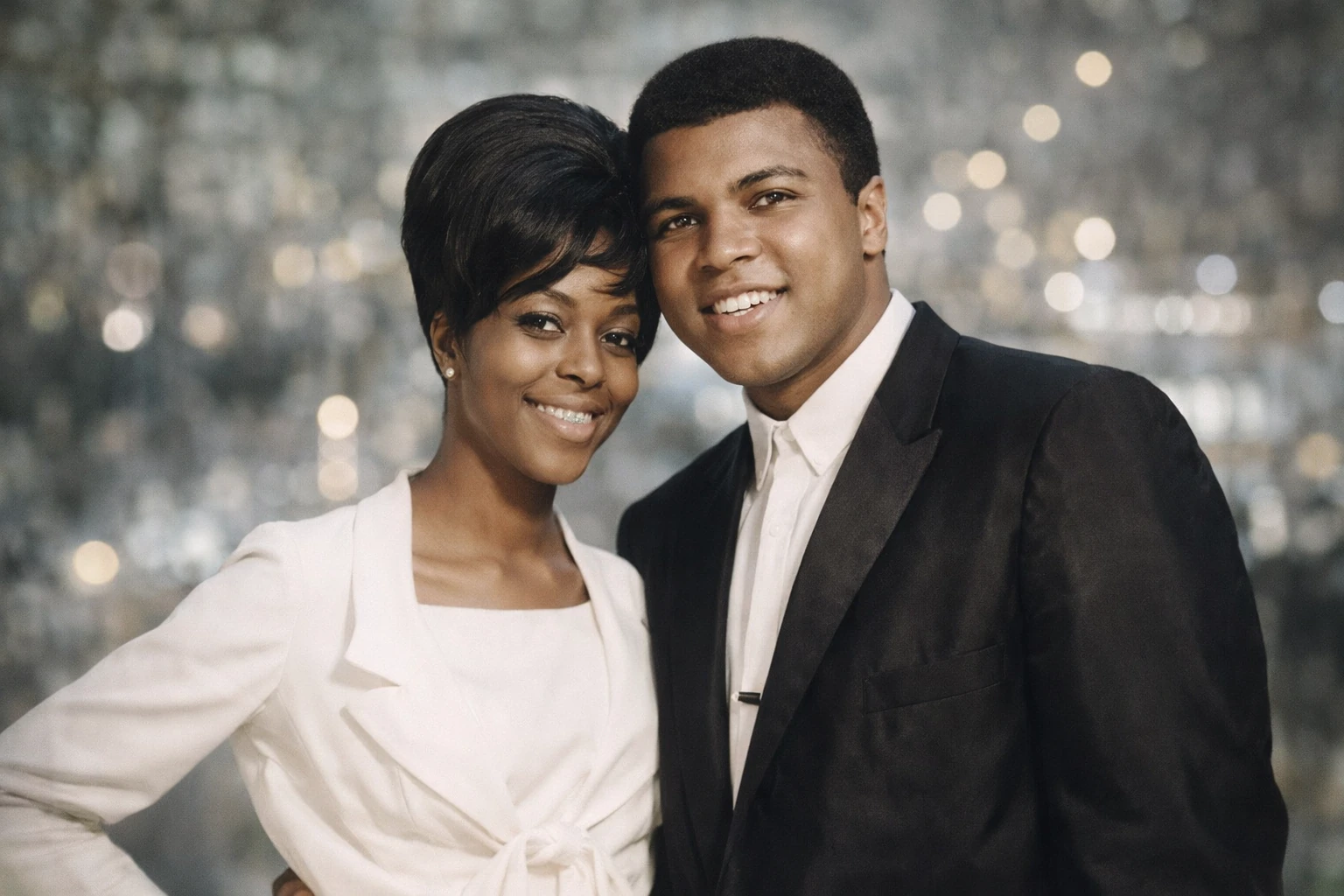
Sonji Roi entered the public eye at a moment when the world was already watching closely. In August 1964, just months after Cassius Clay shocked the boxing world by defeating Sonny Liston and announcing his allegiance to the Nation of Islam, he married a young woman few outside certain social circles had heard of. Her name was Sonji Roi. For a brief period, she stood beside one of the most famous athletes on the planet, her image captured in photographs and headlines. Then, almost as quickly as she arrived in the spotlight, she receded from it, leaving behind a story that remains compelling precisely because it is incomplete.
Her life has often been reduced to a footnote in Muhammad Ali’s biography, but that framing does not do justice to the person behind the name. Sonji Roi was more than a first wife. She was a working woman navigating mid-century American culture, a figure caught between independence and expectation, and someone whose life after fame unfolded largely outside public view. To understand her, it helps to look closely at what can be confirmed, to acknowledge what remains uncertain, and to treat her story with the care it deserves.
Early Life and Background
The details of Sonji Roi’s early life are surprisingly difficult to pin down with certainty. Public records and later accounts often conflict on basic facts such as her birth year and early upbringing. Many sources place her birth in the mid-1940s, with November 23, 1945 frequently cited, though other records suggest slightly different timelines. This inconsistency reflects a broader challenge in documenting her life: much of what survives comes from secondary reporting rather than primary biographical work.
What appears more consistent is that she spent part of her early adult life in the Midwest, with ties to Indiana and Illinois. She has been described as a model and a cocktail waitress, occupations that placed her within the social and cultural networks of the early 1960s. These were environments where fashion, nightlife, and entertainment overlapped, and where ambition often met opportunity in unpredictable ways.
Friends and contemporaries described her as stylish and self-assured, someone comfortable in public-facing roles. That confidence likely helped her move between modeling work and club environments, both of which required a strong sense of presentation. While little is known about her family background or education, the available glimpses suggest a young woman who had already carved out a degree of independence before her name became widely known.
Life Before Muhammad Ali
Before her marriage, Sonji Roi was part of a social scene that intersected with media and entertainment. She reportedly modeled for publications aimed at Black audiences, including Tan magazine, which was part of a growing network of media outlets serving African American readers during that era. Modeling in that context was not only about appearance but also about representing a modern, urban identity.
At the same time, her work as a cocktail waitress placed her in close proximity to entertainers, athletes, and promoters. These spaces often functioned as informal hubs where relationships were formed and opportunities emerged. It was within this environment that she eventually crossed paths with Cassius Clay, who was rapidly becoming one of the most talked-about figures in sports.
The truth is, there is no single, fully documented account of her life before Ali. That absence has led to a tendency among later writers to fill in the gaps with speculation. A more responsible approach is to recognize that she was already navigating a complex and changing social world, one that offered both visibility and risk, before her brief marriage placed her under national scrutiny.
Meeting Cassius Clay
Sonji Roi met Cassius Clay in the summer of 1964, a period of intense transformation in his life. Clay had just defeated Sonny Liston to become heavyweight champion, and he was in the process of publicly aligning himself with the Nation of Islam. His fame was growing by the day, and his personal choices were becoming matters of public debate.
Accounts of their meeting vary in detail, but most agree that they were introduced through mutual acquaintances connected to Ali’s expanding circle. Herbert Muhammad, who would become one of Ali’s closest business associates, is often cited as playing a role in bringing them together. The connection was immediate, and within weeks, their relationship moved from introduction to engagement.
What stands out about their courtship is its speed. Ali, still known to many as Cassius Clay, proposed marriage shortly after meeting her. By August 14, 1964, the two were married in Gary, Indiana. The quick progression from meeting to marriage reflected both Ali’s impulsive confidence and the intense atmosphere surrounding his rise to fame.
Marriage to Muhammad Ali
The marriage between Sonji Roi and Muhammad Ali began under extraordinary circumstances. Ali was not just a sports champion; he was a cultural figure undergoing a public transformation. His decision to embrace Islam and reject his birth name was controversial, drawing both admiration and criticism across the United States.
For Sonji Roi, entering into this marriage meant stepping into a life that was already under scrutiny. She became part of Ali’s public image, appearing in photographs and attending events as his wife. Yet the expectations placed on her were shaped not only by celebrity culture but also by the religious and social framework Ali was increasingly committed to.
Tension emerged quickly. Reports from the time indicate that disagreements over lifestyle and religious expectations were central to the breakdown of the marriage. Ali’s growing adherence to the teachings of the Nation of Islam included specific views about dress, behavior, and the role of women. These expectations did not align easily with Sonji Roi’s background or sense of independence.
The conflict was not simply personal. It reflected broader questions about identity, faith, and autonomy during a period of significant social change. Their marriage became, in a sense, a microcosm of those larger tensions. By 1965, the relationship had deteriorated to the point of legal action, and by early 1966, the marriage was effectively over.
Divorce and Public Attention
The end of the marriage was covered in the press, though often with less detail than might be expected given Ali’s fame. The separation and subsequent legal proceedings were framed largely in terms of incompatibility, with particular emphasis on religious differences. While some accounts suggest that Ali sought an annulment, others describe the process as a divorce, reflecting the lack of consistent documentation.
For Sonji Roi, the divorce marked a turning point. Her association with Ali had brought her into the public eye, but it also meant that her identity was tied closely to his. Once the marriage ended, she faced the challenge of defining herself independently in a media environment that had little interest in her beyond that connection.
The attention she received during and immediately after the marriage did not translate into long-term visibility. Instead, her public profile began to fade, even as Ali’s continued to grow. This contrast would shape how her story was remembered in the years that followed.
Attempts at a Music Career
After her separation from Ali, Sonji Roi made an effort to establish a career in music. In 1966, she was featured in Jet magazine as she began pursuing singing, a move that suggested both ambition and a desire to create a new public identity. She recorded several singles under the name Sonji Clay, indicating a professional commitment rather than a passing experiment.
Music industry records confirm that she released at least a handful of tracks between the mid-1960s and late 1960s. These recordings did not achieve widespread commercial success, but they demonstrate that she was actively working within the industry. For a woman emerging from a highly publicized marriage, this effort represented a clear attempt to move forward on her own terms.
The reception to her music career appears to have been modest. Without the backing of major labels or sustained media attention, her work did not reach a broad audience. Still, the fact that she recorded and released music places her among a group of individuals who sought to transition from peripheral fame into independent careers.
Later Life and Personal Relationships
Details about Sonji Roi’s later life are limited, but some elements can be confirmed through public records and memorials. She later used the name Sonji Clay-Glover, indicating that she remarried. Her husband has been identified as attorney Reynaldo Preston Glover, though information about their relationship remains sparse.
Her life in these later years appears to have been largely private. Unlike many figures connected to major celebrities, she did not maintain a public presence or seek ongoing media attention. This choice, whether intentional or circumstantial, contributed to the scarcity of information about her beyond her early adulthood.
The lack of detailed reporting on her later years has led to speculation, but there is little verified evidence to support most of it. What can be said is that she lived outside the spotlight that had briefly defined her public image. This quieter phase of her life stands in contrast to the intense visibility of her marriage to Ali.
Death and Legacy
Sonji Roi died on October 11, 2005, in Chicago. She was 59 years old, according to commonly cited records, though as with other aspects of her life, the exact details depend on which sources are consulted. Reports at the time indicated that she was found in her home and that her death was attributed to natural causes. Some family members suggested a possible heart attack, but this was not confirmed as an official cause.
Her passing did not generate widespread media coverage, a reflection of how far she had moved from the public spotlight. Yet her name continued to appear in discussions of Muhammad Ali’s life, particularly in retrospectives and biographies. This enduring association has shaped her legacy in ways that both preserve and limit her story.
In 2001, Sonji Roi was portrayed by Jada Pinkett Smith in the film Ali, bringing her story to a new generation. The film’s depiction, while dramatized, renewed interest in her life and introduced her to audiences who might not have encountered her otherwise. Even so, the portrayal also highlighted how much of her story remains open to interpretation.
Public Image and Cultural Context
Sonji Roi’s public image has always been closely tied to her brief marriage, but it also reflects broader cultural themes. She emerged at a time when Black women were navigating new forms of visibility in media and public life. Modeling, television appearances, and music offered avenues for expression, but they also came with constraints shaped by both race and gender.
Her story intersects with the history of the Nation of Islam, the civil rights movement, and the changing role of women in American society. These contexts help explain why her marriage to Ali carried significance beyond personal matters. It was not just about two individuals but about competing ideas of identity and freedom.
At the same time, her relative obscurity in later years raises questions about how stories are preserved. Figures who stand near major historical events are often remembered only in relation to those events, rather than as individuals with their own trajectories. Sonji Roi’s life illustrates how easily a person can be both visible and overlooked.
Net Worth and Financial Standing
There is no reliable public estimate of Sonji Roi’s net worth. Unlike many contemporary figures, she did not maintain a long-term career in highly documented industries such as film or major-label music. Her income sources likely included modeling, club work, and later music recordings, but detailed financial records are not available.
It is also unclear whether she received any financial settlement from her marriage to Ali, as such details were not widely reported. Without confirmed information, any attempt to assign a net worth figure would be speculative. The absence of financial data is consistent with the broader pattern of limited documentation surrounding her life.
Where Sonji Roi Fits in History
Sonji Roi’s place in history is tied to a specific moment, but it extends beyond it. She represents a group of individuals whose lives intersect with major figures at critical junctures, shaping and reflecting those moments in subtle ways. Her marriage to Ali coincided with one of the most important transitions in his life, and her presence during that time offers a glimpse into the personal side of a public transformation.
Her story also highlights the limits of historical memory. While Ali’s life has been documented in extraordinary detail, the lives of those around him are often recorded only in fragments. This imbalance shapes how we understand the past, emphasizing certain narratives while leaving others incomplete.
Frequently Asked Questions
Who was Sonji Roi?
Sonji Roi was the first wife of Muhammad Ali and a model and aspiring singer who gained public attention during their short marriage in the mid-1960s. She later lived a more private life and died in Chicago in 2005.
How long was Sonji Roi married to Muhammad Ali?
She married Ali on August 14, 1964, and their marriage ended by early 1966. The relationship lasted less than two years and was marked by differences in lifestyle and religious expectations.
What did Sonji Roi do for a living?
Before and after her marriage, she worked as a model and cocktail waitress and later pursued a music career. She recorded several singles in the 1960s, though they did not achieve major commercial success.
Did Sonji Roi have children?
There is no widely confirmed public record indicating that Sonji Roi had children. Most reliable sources do not mention any, and claims about her family life should be treated with caution.
How did Sonji Roi die?
She died on October 11, 2005, in Chicago. Her death was reported as due to natural causes, though some family members suggested a possible heart attack.
Was Sonji Roi portrayed in a movie?
Yes, she was portrayed by Jada Pinkett Smith in the 2001 film Ali, which dramatized the life of Muhammad Ali and included their marriage as part of the story.
Conclusion
Sonji Roi’s life resists easy summary. She was briefly at the center of global attention, then spent decades largely out of it. That contrast can make her story feel incomplete, but it also makes it honest. Not every life tied to fame follows a neat arc or leaves behind a detailed record.
What remains is a portrait built from fragments: a young woman moving through the social worlds of the 1960s, a marriage formed in the glare of sudden celebrity, and a later life lived with far less visibility. Each piece adds to the whole, even if the full picture remains just out of reach.
Her story matters not because it fills every gap, but because it reminds us that history often preserves moments rather than entire lives. Sonji Roi’s name endures because of where she stood at one turning point, but her life extended far beyond it, shaped by choices and circumstances that deserve to be acknowledged, even when they cannot be fully known.
